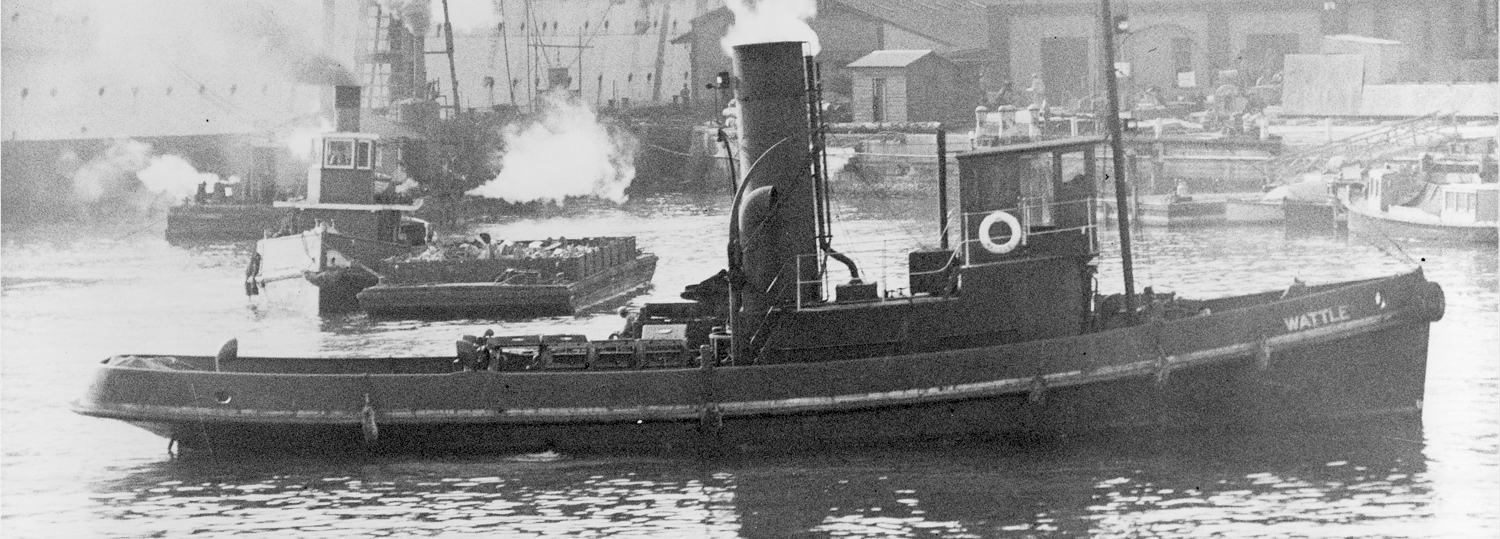
The Lyons government was anxious to remove Cockatoo Island from Commonwealth control because of its continuing financial losses and incapacity to operate in the heavy engineering open market, due largely to a High Court judgement of 1927. The decision to build a small tug was part of an incentive package by the Lyons Commonwealth Government (January 1932) to make the Cockatoo Island ship construction and maintenance facility attractive to a potential private leaseholder.
The General Arrangement drawings for a small tug, ship number 111, were completed by Cockatoo Island in April 1932, based on, but not a copy of, drawings of an earlier steam tug, the Bustler (1917). The construction of the tug commenced in 1932 before the dockyard was leased to Cockatoo Docks & Engineering Co. Ltd (Codeco) on 3 February 1933. After this date and up to its transfer to the Royal Australian Navy the tug was referred to as 'Codeco'. This small tug became the last ship built at Cockatoo Island for the Commonwealth Shipping Board, signaling the subsequent transfer of all the shipbuilding and maintenance facilities on the island from the Commonwealth to the private lessee.
On 13 March 1933 the Sydney Morning Herald reported that the new lessee management, in reviewing their first week of operations at Cockatoo Island since taking over the site, noted that a small tug was under construction and did not have an intended purchaser or purpose at that time.
On 27 June 1933 the completed hull of the tug Codeco was lifted into the water at Cockatoo Dockyards by the floating crane Titan. Codeco was then slipped for further fitting out. See Wattle's technical specifications at October 1933.
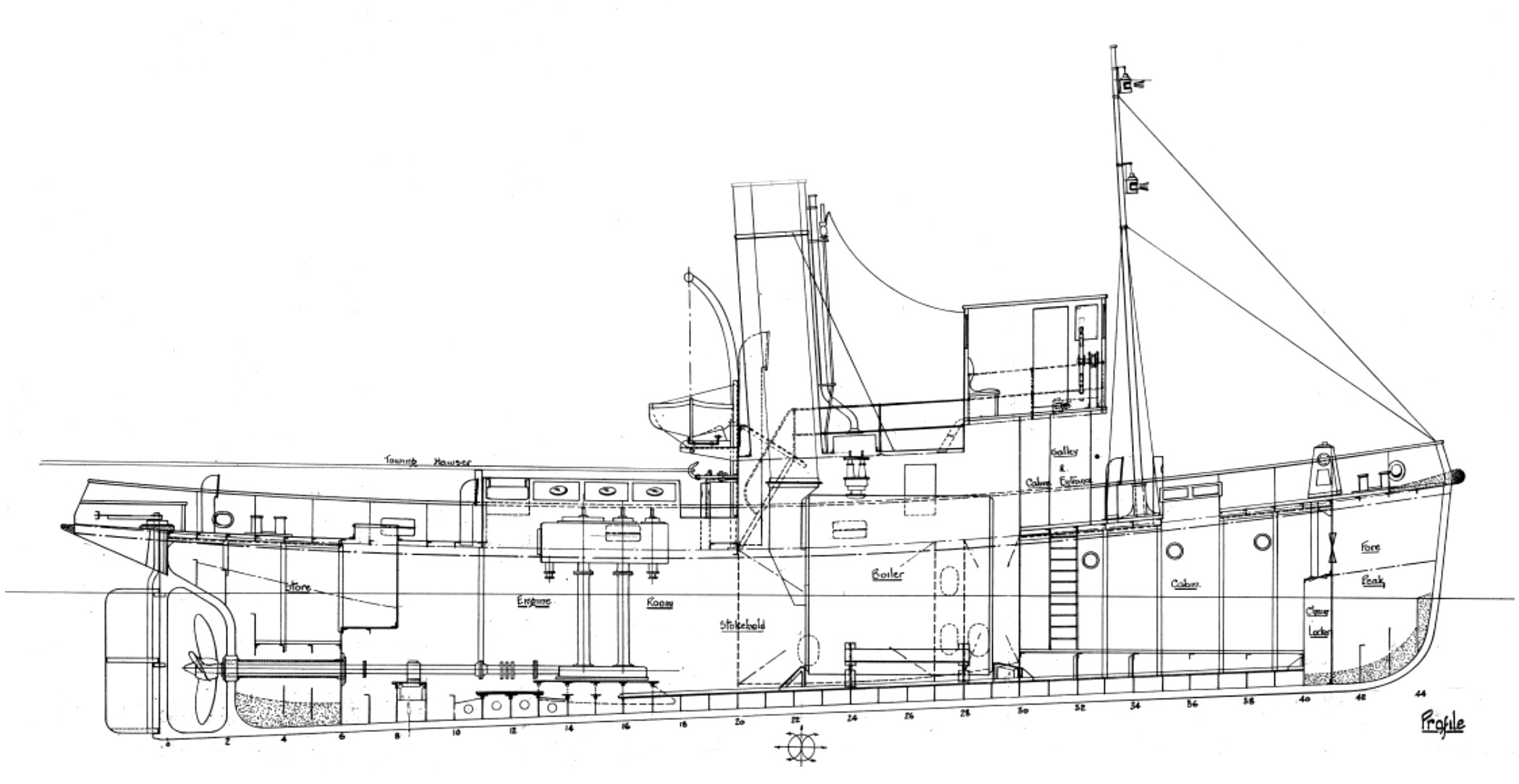
General Arrangement profile of ship No. 111. Source: National Australian Archives
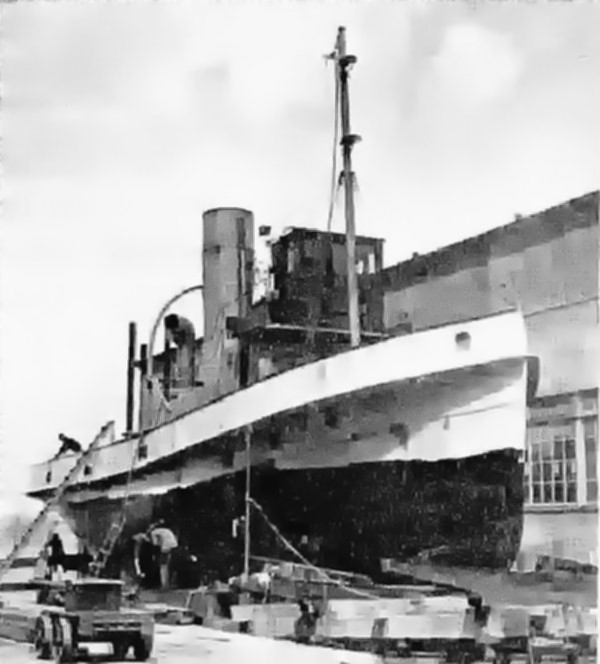
Codeco, fitting out, 24 November 1933. Source: Sydney Morning Herald
First trials occurred on 8 November 1933, during which Wattle achieved a mean speed of 10.6 knots at 133 rpm in "light" condition of 118 tons. As a result of inclining tests carried out in January 1934, three tons of concrete and iron billets were added as ballast in the forward, boiler, engine and aft compartments (Hope 1989). It was this ballast that created a long term hull and plate corrosion problem the 2009 restoration group had to address.
Coincidently during October 1933, the RAN expressed some interest in Codeco as it had recently lost a small tug due to collision. Consequently, on 28 December 1933 the Commonwealth government approved the transfer of Codeco to the RAN without cost.
On 15 February 1934 Codeco was renamed the Wattle as a non-commissioned vessel of the RAN operating in the Sydney region with a civilian crew. For its near forty-year life with the RAN, Wattle was engaged in a variety of harbor duties, including maneuvering smaller warships, towing targets and barges, rescue work and transporting goods and personnel between ships and shore. During World War II, Wattle was also engaged in degaussing experiments.
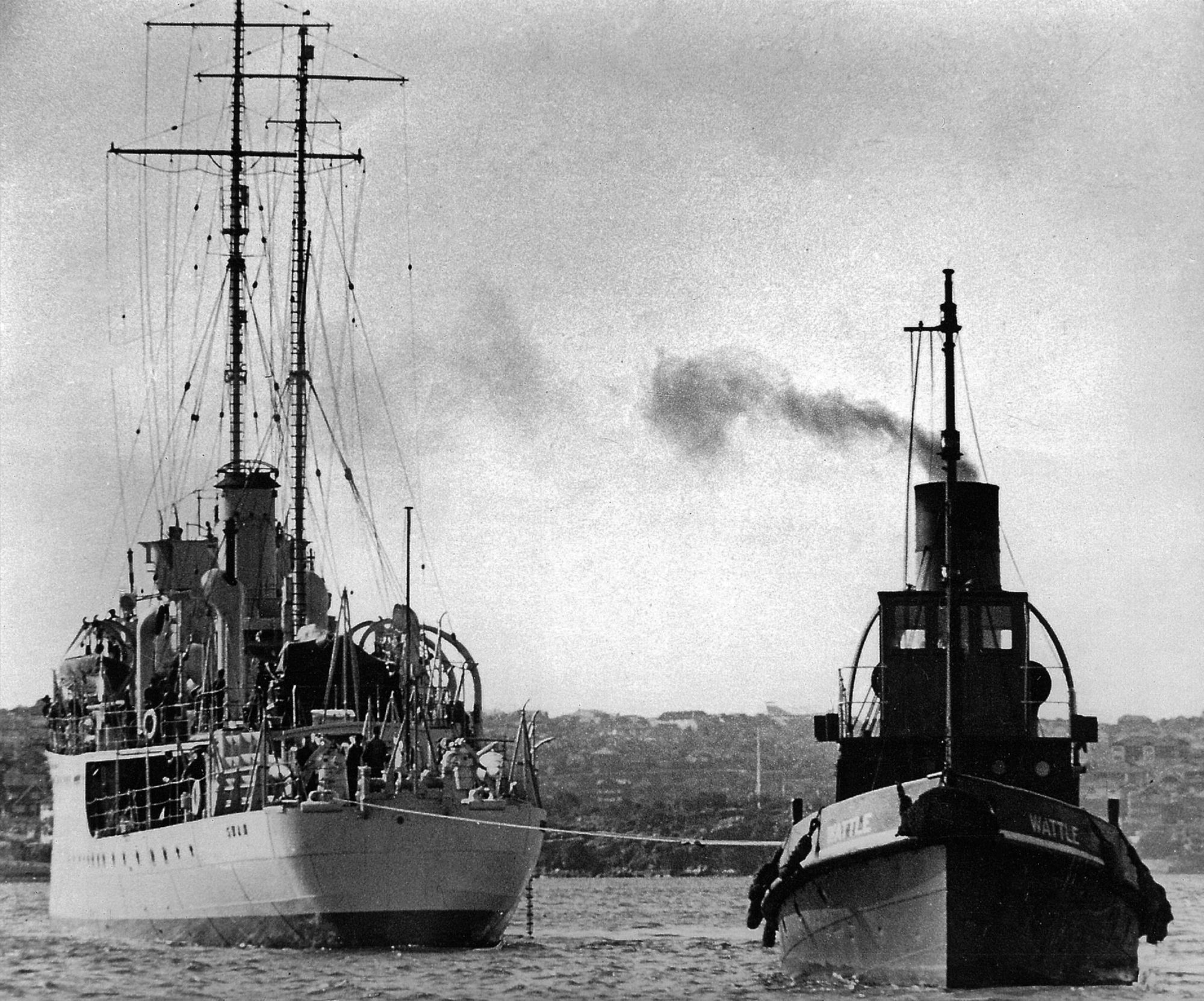
Compass swing for HMAS Swan, Sydney 1937

Wattle at Garden Island 1939

With HMAS Australia, 1938
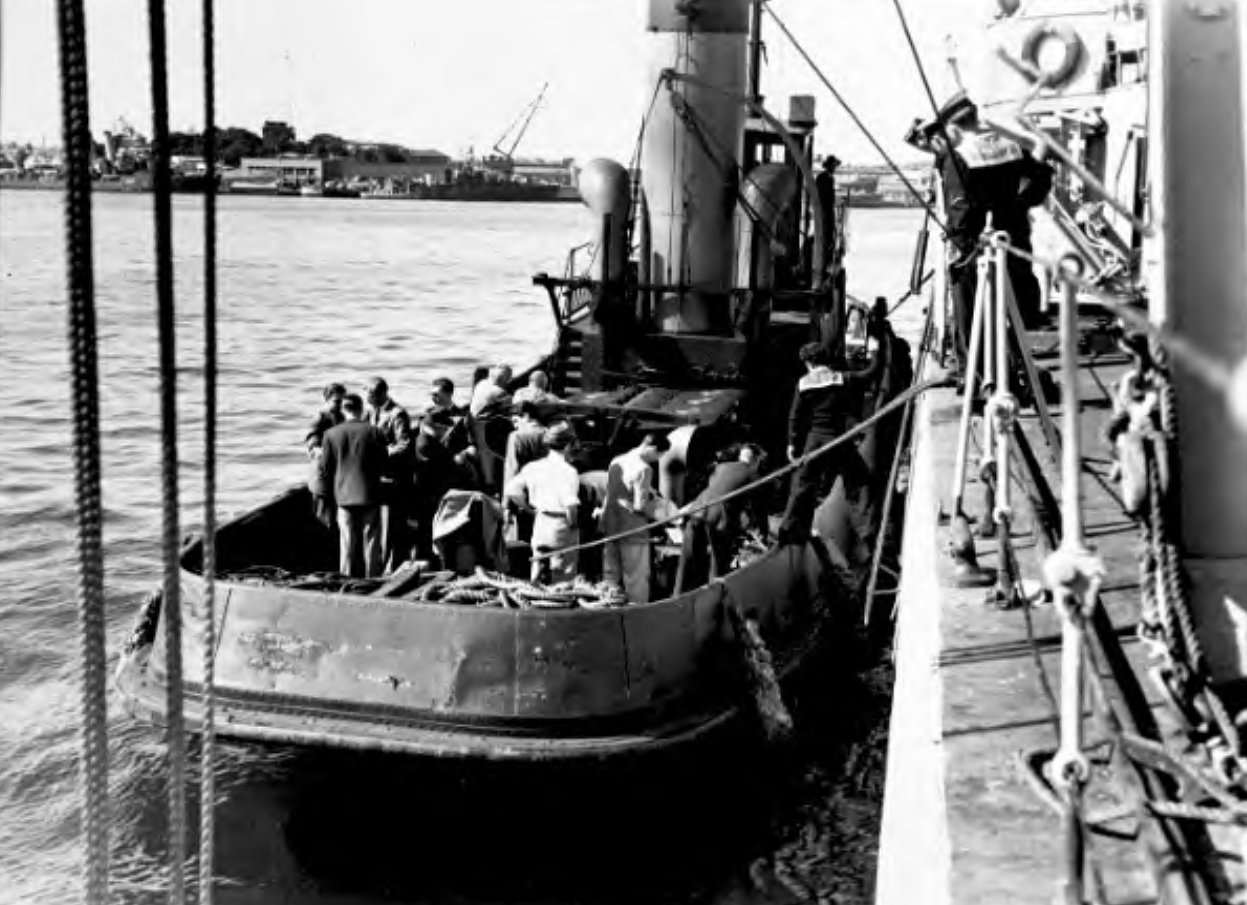
With a Tribal class destroyer, 1948
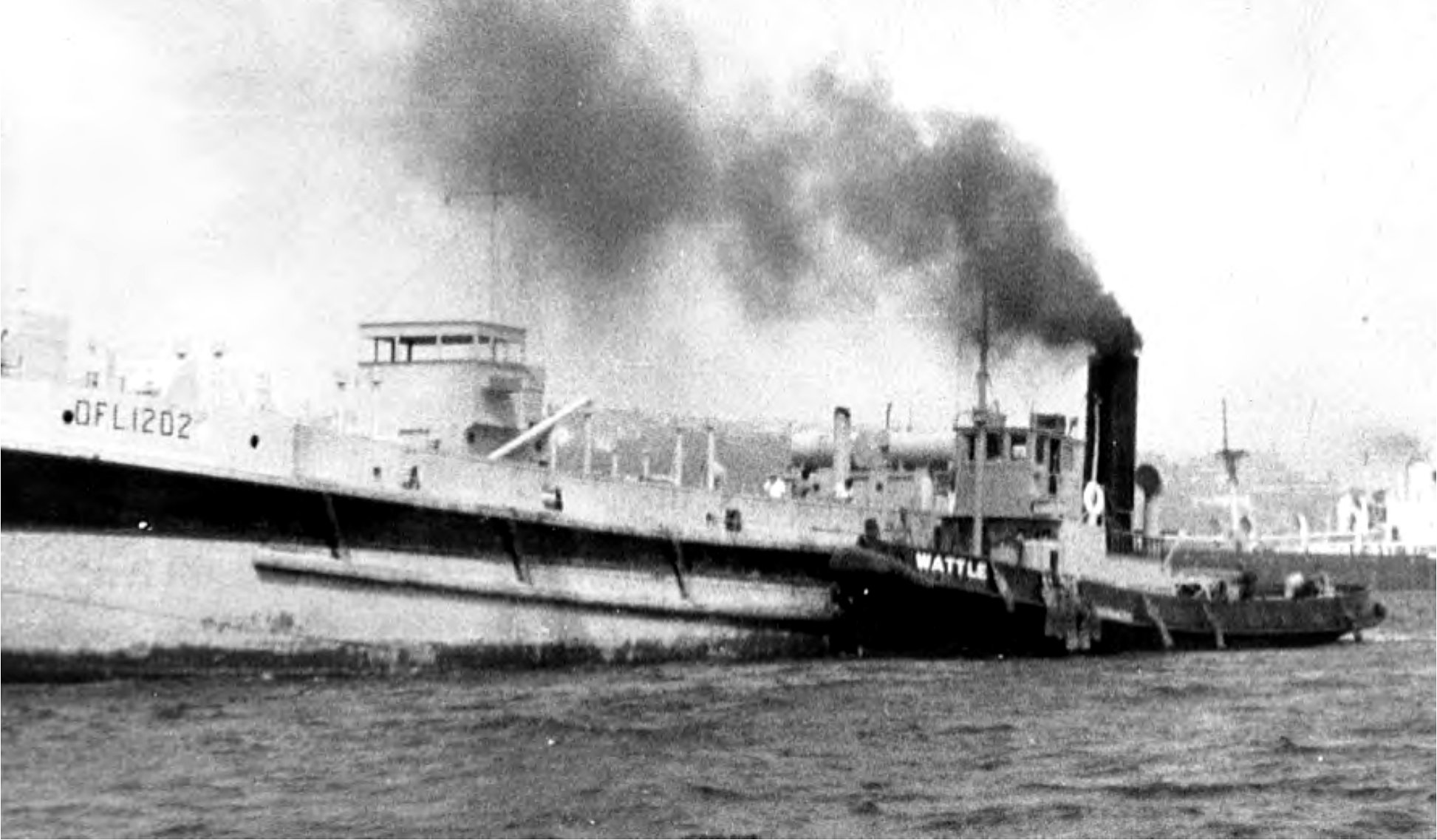
Working a barge 1967, Graeme Andrews Collection
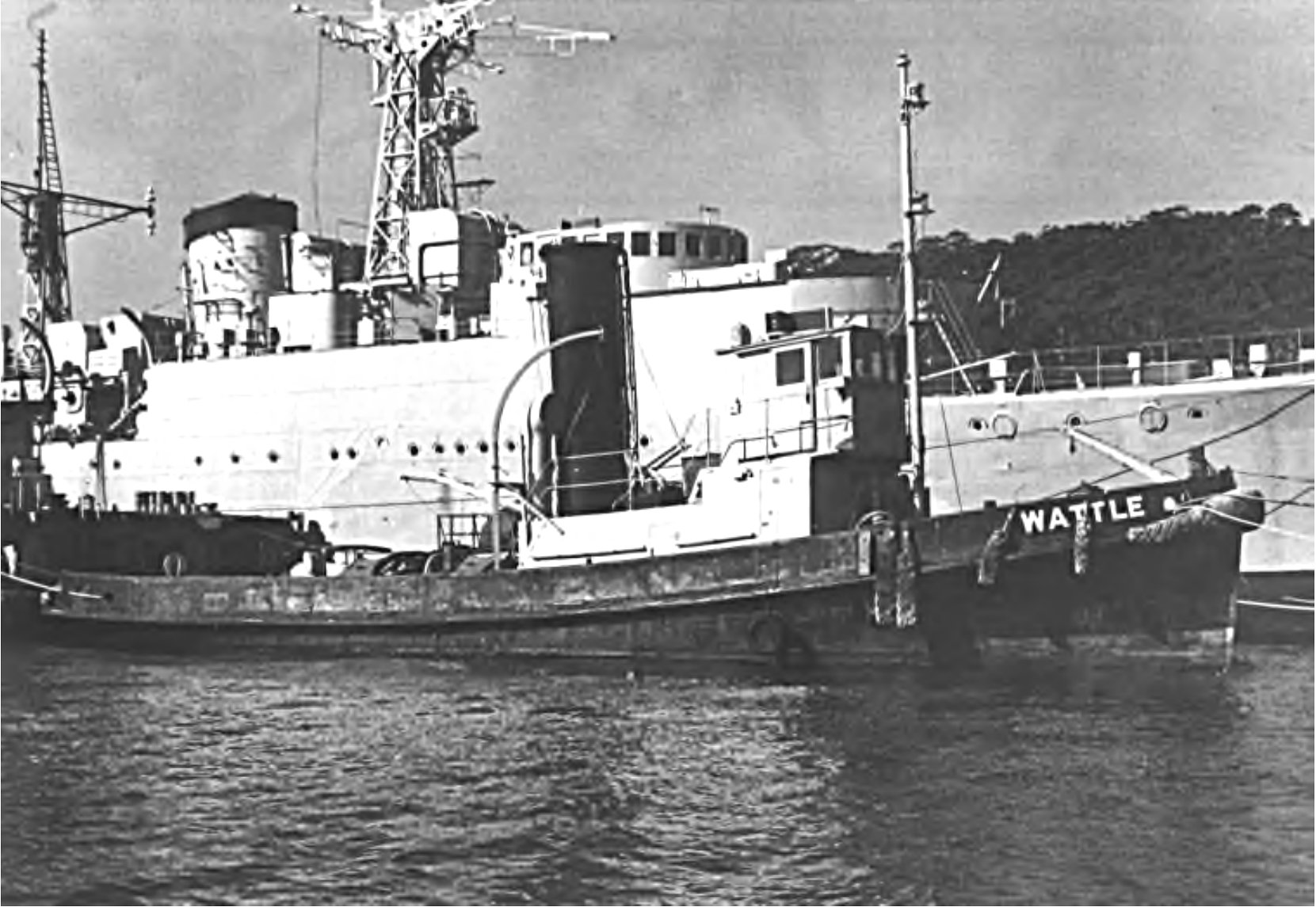
With HMAS Quiberon, Athol Bay 1969
Apart from being a harbor tug with limited endurance and power, a major concern with Wattle was its maneuverability in a harbor environment. Wattle was found to be hard on the helm, requiring considerable effort to accurately steer in tight situations. Consequently a steam steering engine taken from a Sydney ferry was fitted on deck just aft of the engine room in September 1942.
After a long service period with the RAN Wattle was paid off in 1969 and put with the 'reserve fleet' at Athol Bay, in expectation of being sold for scrap.
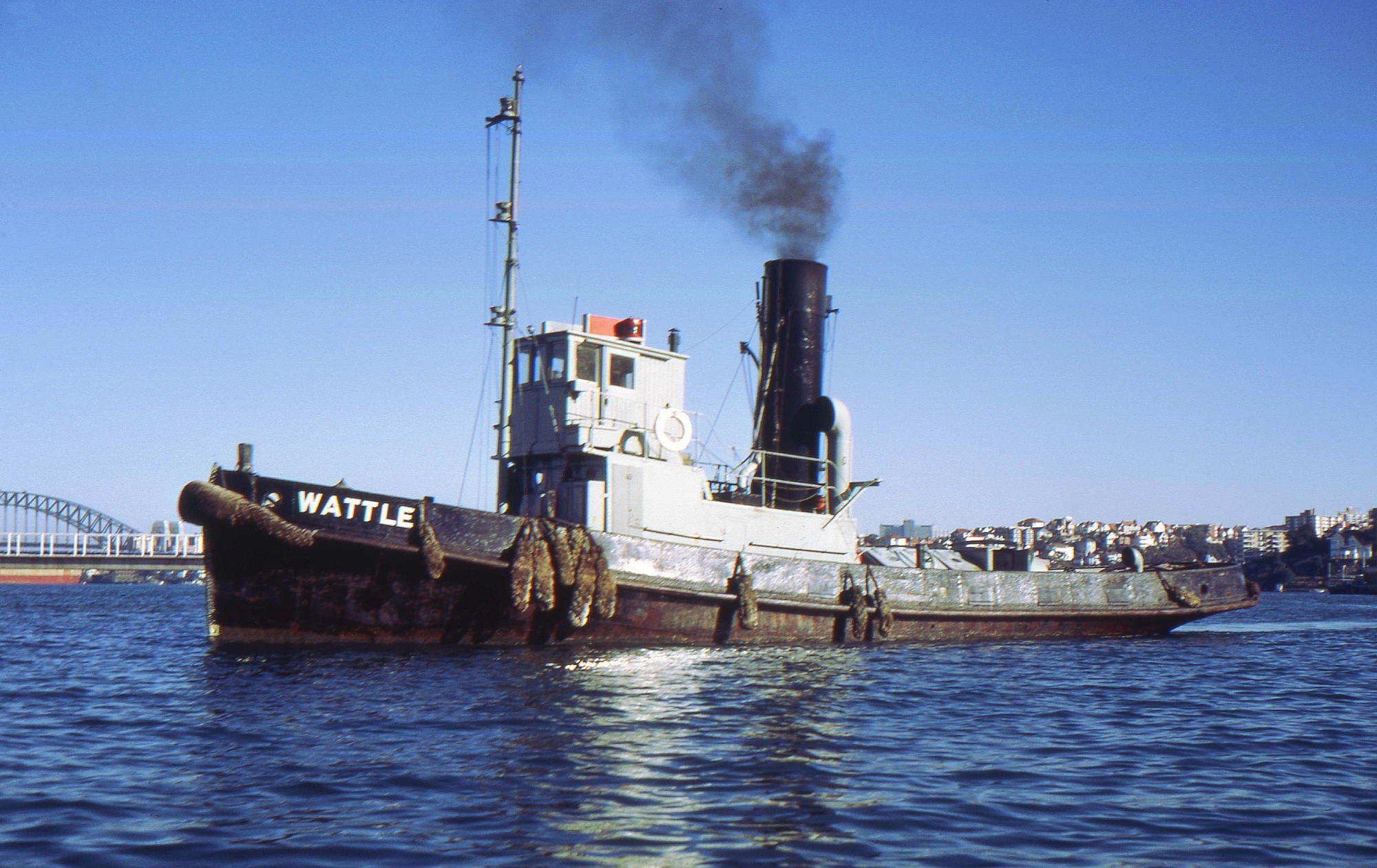
Wattle in RAN colours in Sydney, 1960s
In the early 1960s a group of Sydney-based marine steam enthusiasts made an unsuccessful bid to save the tug Bustler from the wreckers. At that time they were aware the Wattle was approaching the end of its life with the RAN, but turned their attention to acquiring and restoring other steam ships (Lady Hopetoun, Waratah and John Oxley), and in the process established the Sydney Maritime Museum.
Warwick Turner, a young advertising executive with a passion for vintage steam, was one of this group of five and later became a member of Bay Steamers Maritime Museum when Wattle moved to Melbourne, as well as becoming a stalwart of paddle steamers on the Murray River at Echuca.
After Wattle was paid off in 1969, the Sydney group established close liaison with officials at Garden Island naval base to declare their interest in preserving the ship and to stave off any would-be attempt to sell her for scrap. When Wattle was passed from the RAN to the Department of Supply for disposal in 1971, the syndicate of five joined together and submitted a tender of $1,500 based on the estimated scrap value of the ship.
After winning the tender the group steamed Lady Hopetoun to Athol Bight, lashed Wattle to her side and towed the tug to Blackwattle Bay, to moor alongside the other ships of the Sydney Maritime Museum. Wattle did not become part of the collection of vessels as the museum was fully occupied with the restoration of their own ships, including the recently acquired James Craig.
Wattle remained separately owned by the syndicate, which maintained and steamed the ship on Sydney Harbour, mainly for friends and members of the museum. However, the five syndicate members experienced limitations on the time and effort they could spend on the tug. The museum and its growing collection of ships, plus families and career moves eventually led to the decision to hand Wattle over to another party interested in preserving maritime steam.

Wattle at The Spit 1974, Graeme Andrews Collection

Alongside John Oxley at Simmons Point 1974
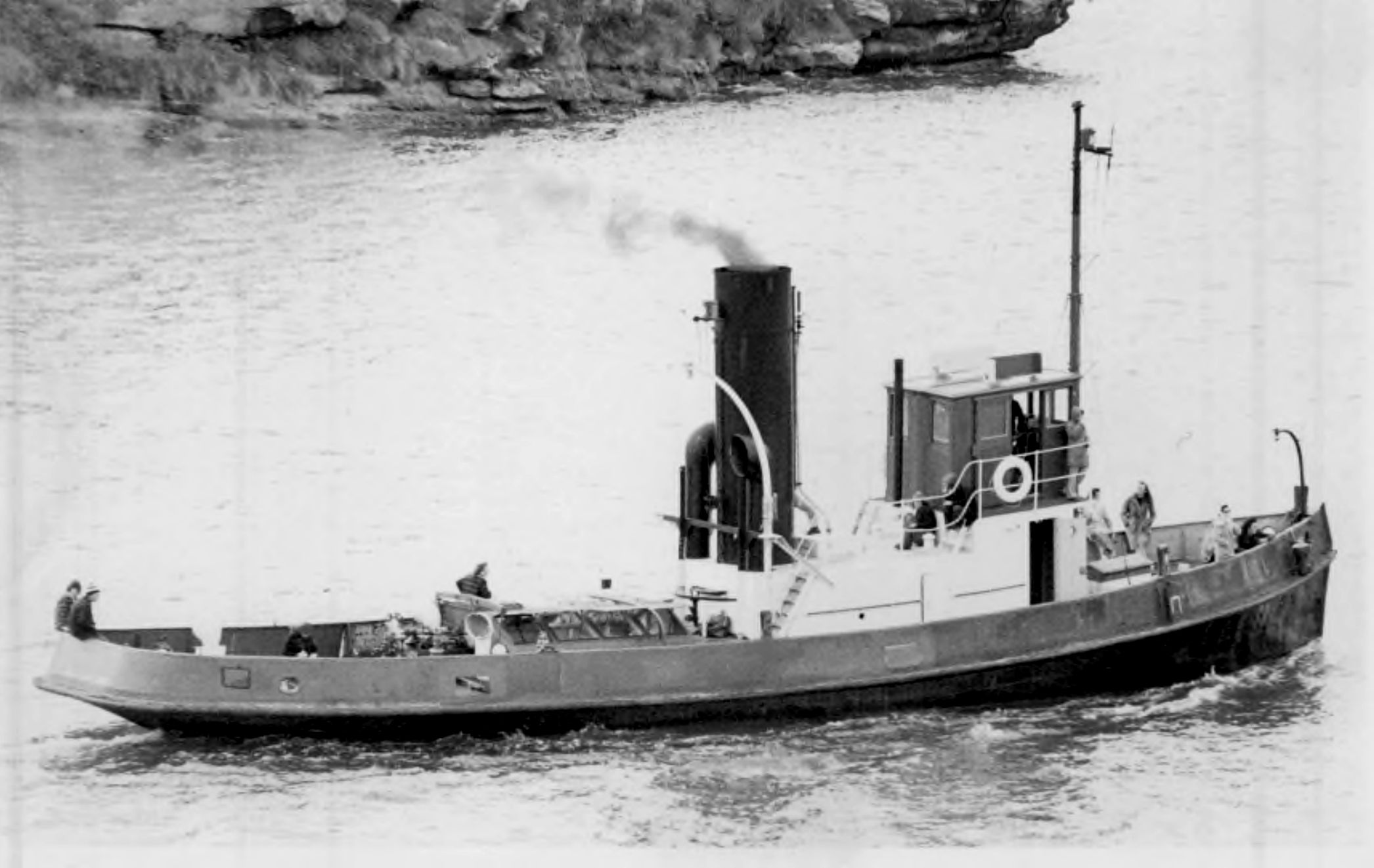
On an excursion in 1975, Graeme Andrews Collection
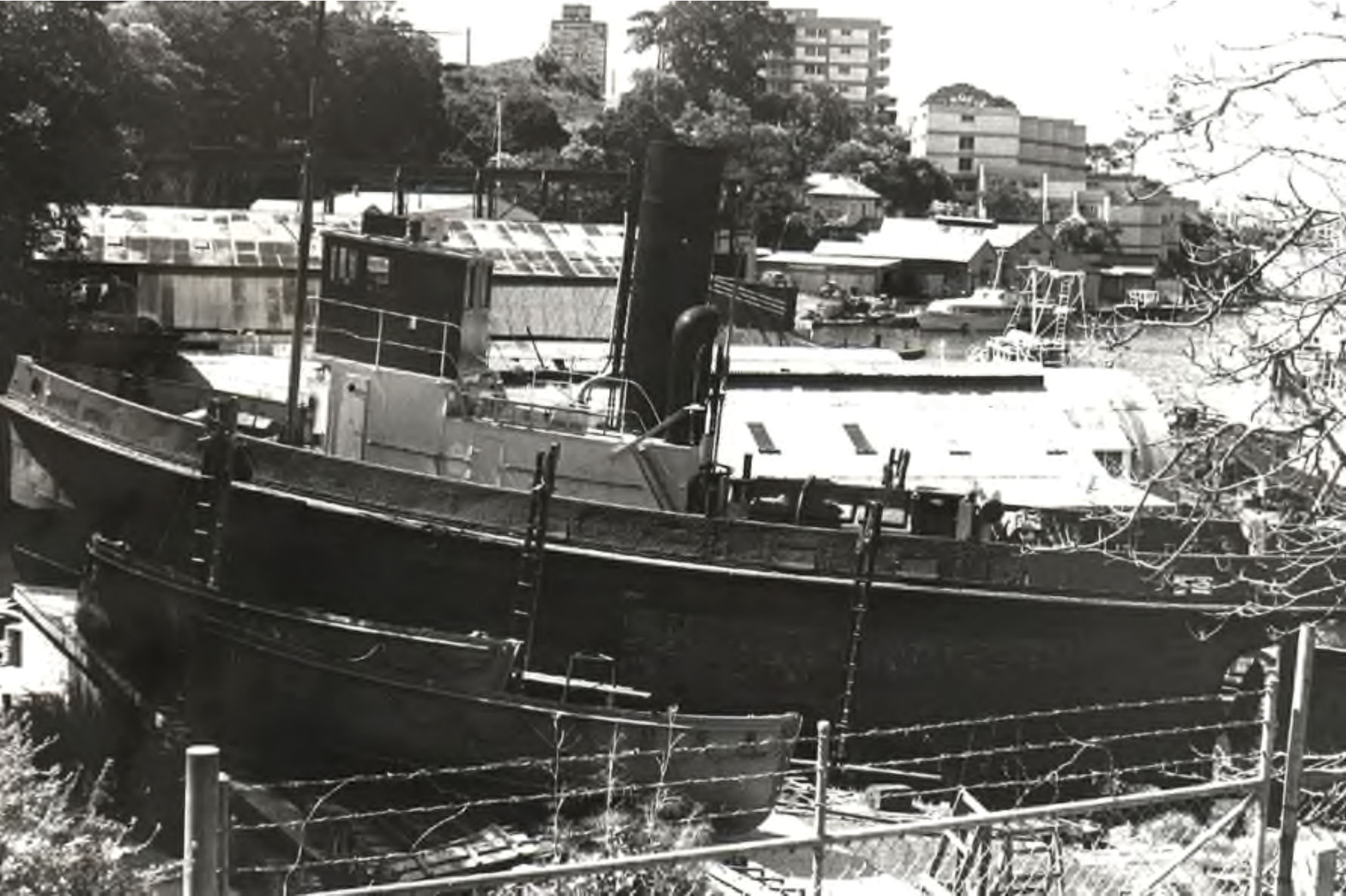
On the slip at Berry's Bay 1978

In the late 1970s, Sydney
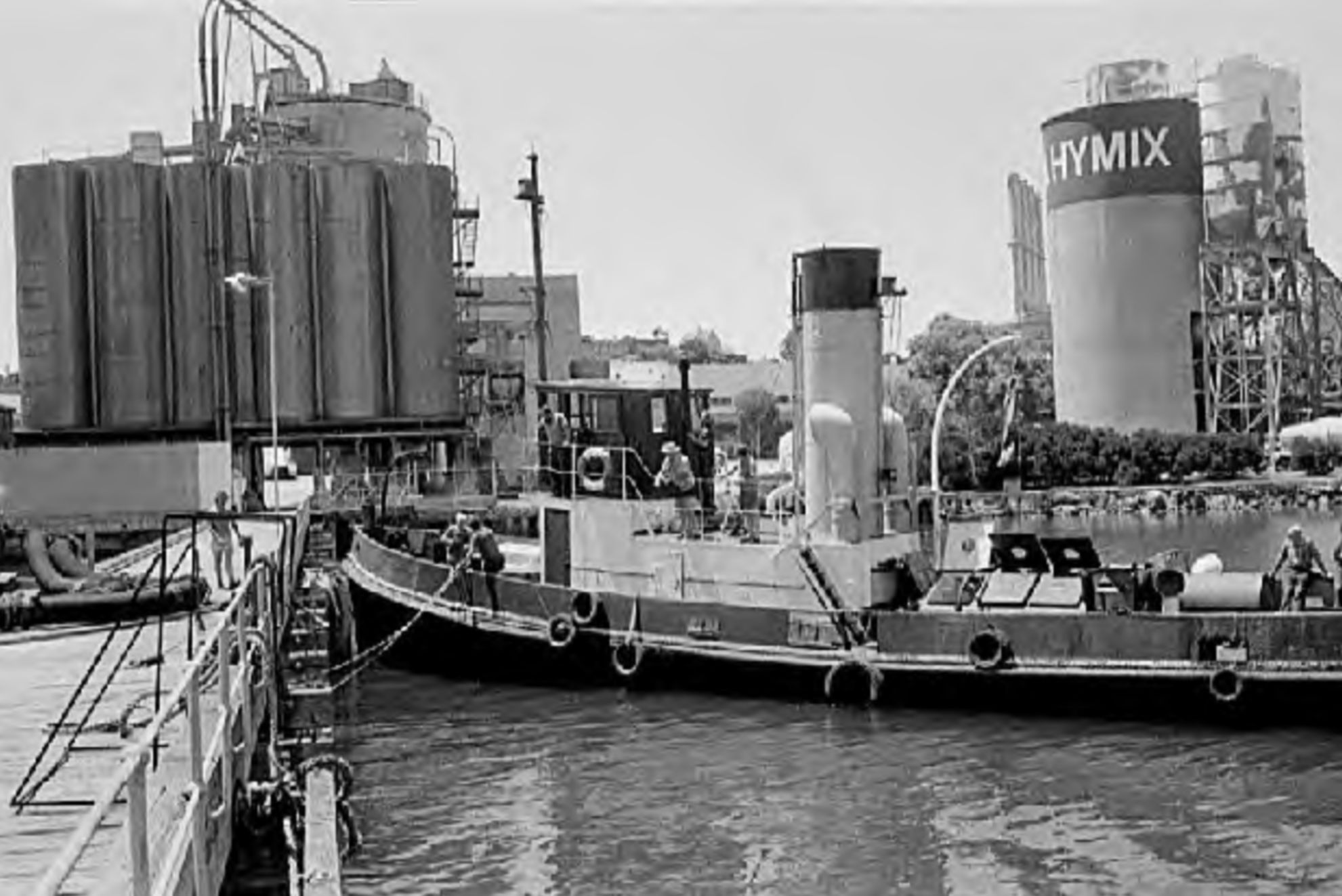
At Blackwattle Bay 1979
In 1976 Leigh Doeg, a young man with a passion for vintage steam ships, formed a small not-for-profit volunteer group, the Victorian Steamship Association (VSA), to acquire a vessel to operate on Port Phillip. Leigh was aware of the problems the Sydney syndicate was experiencing with Wattle, and commenced discussions concerning its preservation. During 1978 the syndicate agreed to gift Wattle to the VSA in an unencumbered state. Before accepting the ship Leigh had her slipped at Berry Bay in November 1978 for inspection and maintenance.
In January 1979 Leigh and Murray Hill (a marine engineer and member of VSA) raised steam on the Wattle and completed test runs of the ship on Sydney Harbour, assisted by a scratch crew from the Sydney Maritime Museum. Later that year Wattle was towed to Melbourne by the Howard Smith tug Edina, arriving on 11 September 1979. The tow was a gift from Howard Smith to the VSA and the people of Melbourne.
VSA volunteers began a major restoration program at 20 Victoria Dock to bring Wattle into commercial passenger survey. Coincidently, the berth at Victoria Dock also marked the start of an ongoing association with the sail-training schooner Alma Doepel, also undergoing restoration at that time.
From 1980 restoration progressed with a small volunteer workforce, in-kind donations from industry and supporters, and limited finances. Restoration accelerated in 1984 when VSA received a grant of $110,000 from the Community Employment Program to engage long-term unemployed people, and the Victorian Government invested $45,000 from the Victorian Economic Development Committee in the Wattle restoration.
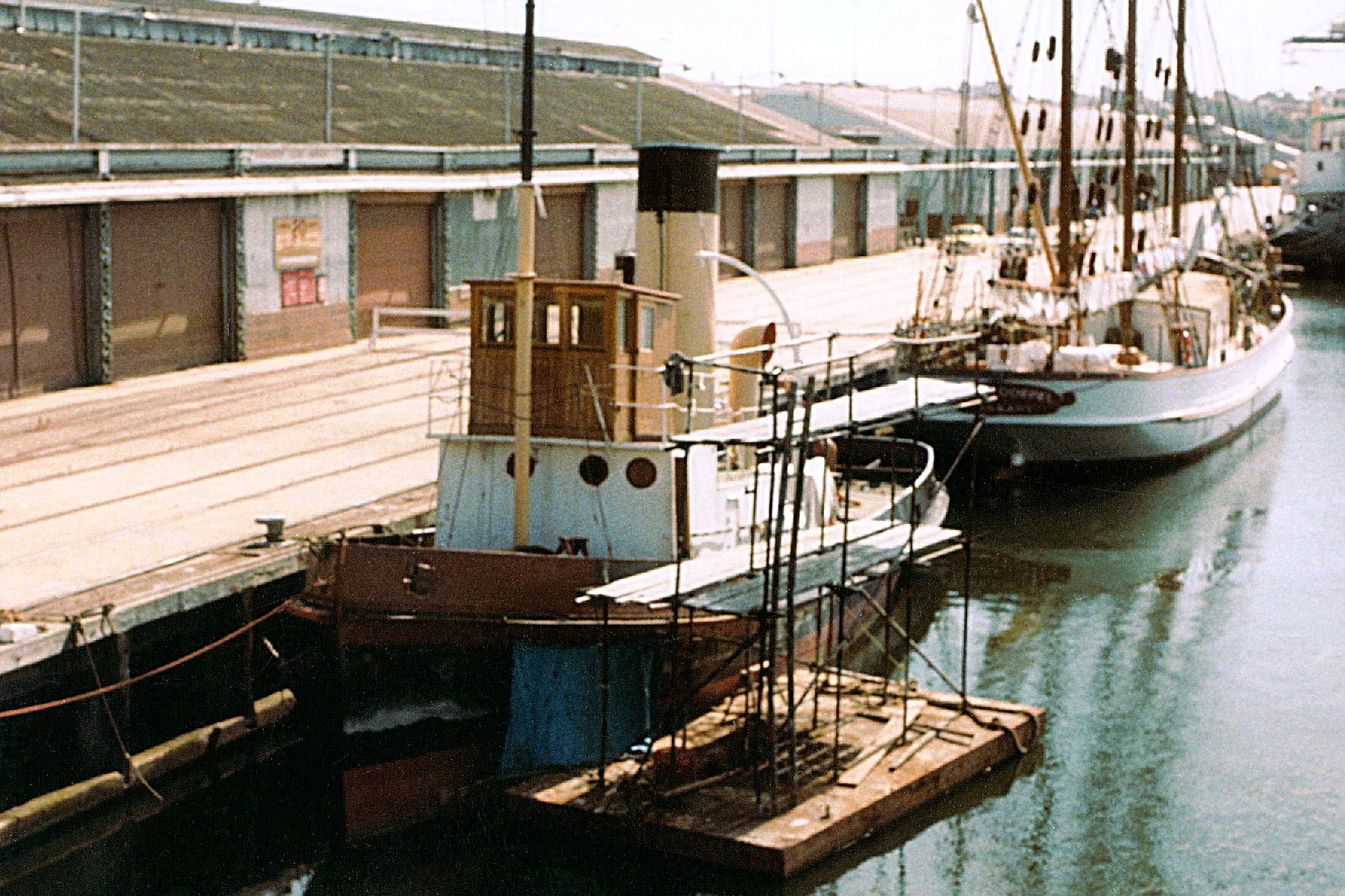
With Alma Doepel at Victoria Dock 1984
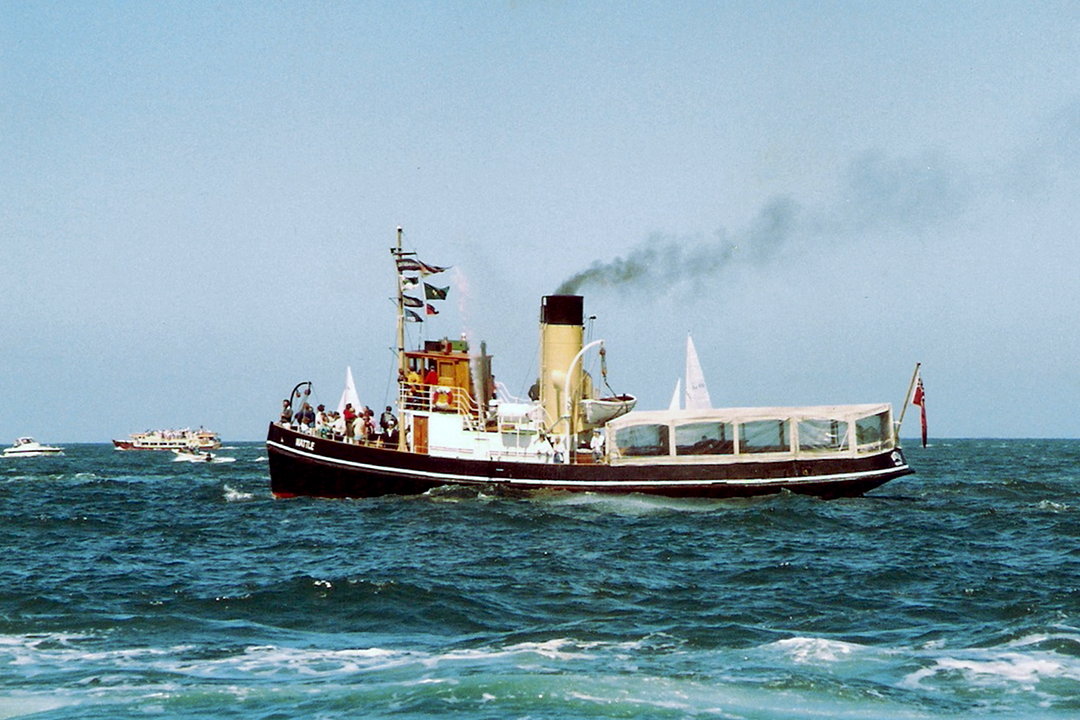
Wattle 1988, Rob Newland
From 1985 cruises began on Hobsons Bay and the Yarra River, and in 1986, Wattle obtaining survey to carry up to 50 passengers and 5 crew on Port Philip. The VSA commenced a regular commercial service, with two hour cruises on Sundays on the Yarra and Hobsons Bay, and all-day return cruises on Saturdays to Portarlington.
Private charters were available for special events, birthdays, weddings, anniversaries and corporate functions, and VSA located the ship at Rye pier on the Mornington Peninsula during the December-January summer holidays, and took holiday-makers onto the bay to view seals on the Port Phillip channel markers. By 1987 Wattle was a familiar sight steaming around the Melbourne waterside.
The 1988 Bi-Centennial celebrations raised Wattle's profile and activity, and on 30 December 1987, the tug led the International Tall Ships Fleet to their overnight berth off Rye and next day to Station Pier Melbourne.
On 16 January 1988, Wattle steamed from Rye to Portsea to be the official start boat for the Petersville Regatta yacht race to Devonport. Unfortunately two of the Pit Special aerobatic planes putting on a show before the start of the race collided, with one crashing into the sea just ahead of Wattle. Captain Ralph McDonell, in charge of the Wattle, played a key part in communications and initial search actions at this incident.
In March 1988 Wattle was part of the welcoming fleet to Melbourne for the First Fleet Re-enactment sailing ships, and over subsequent years Wattle established a profile of pleasure cruises around Port Phillip.
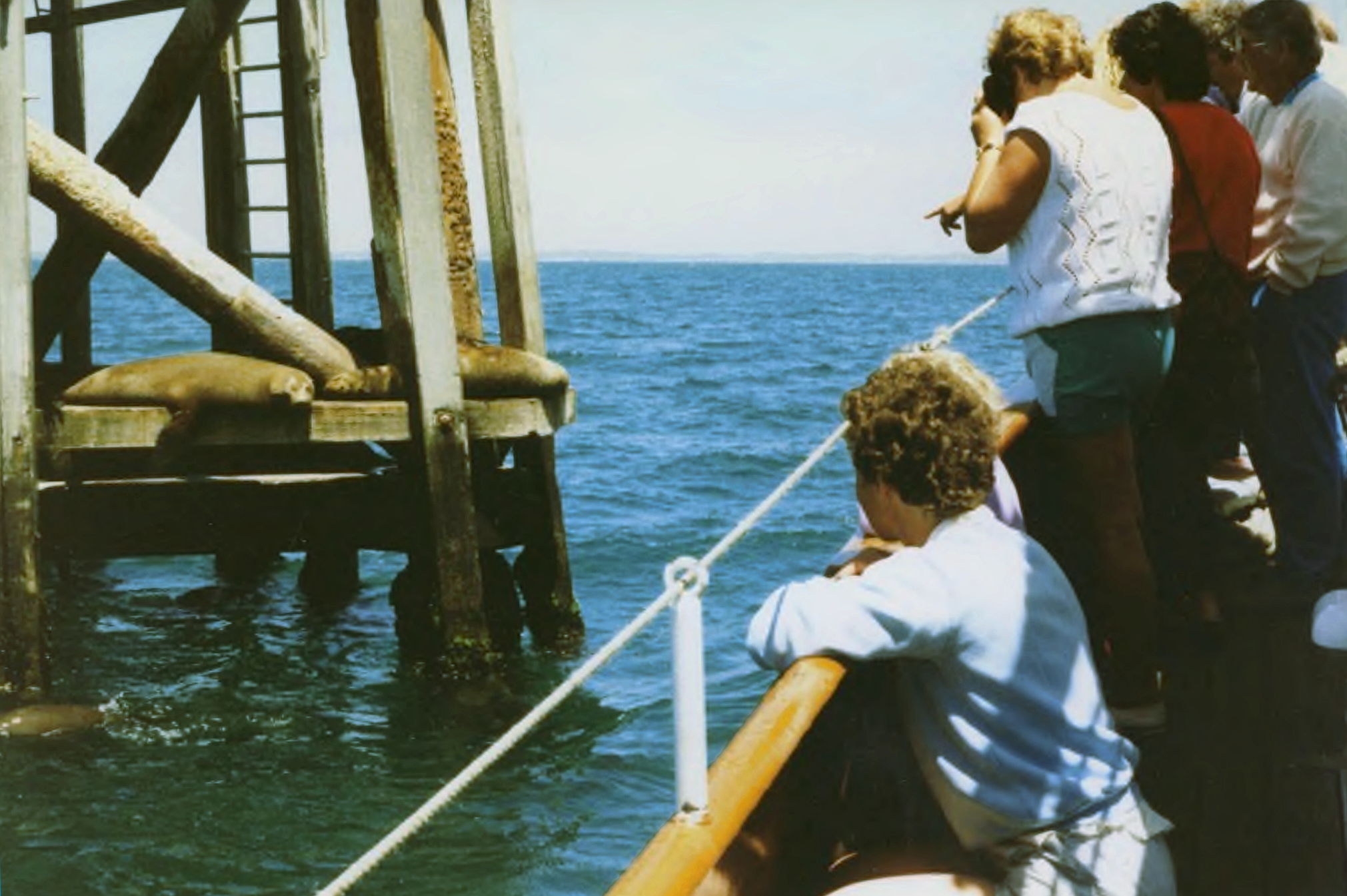
Viewing seals at South Channel Marker 1986, Jeff Malley
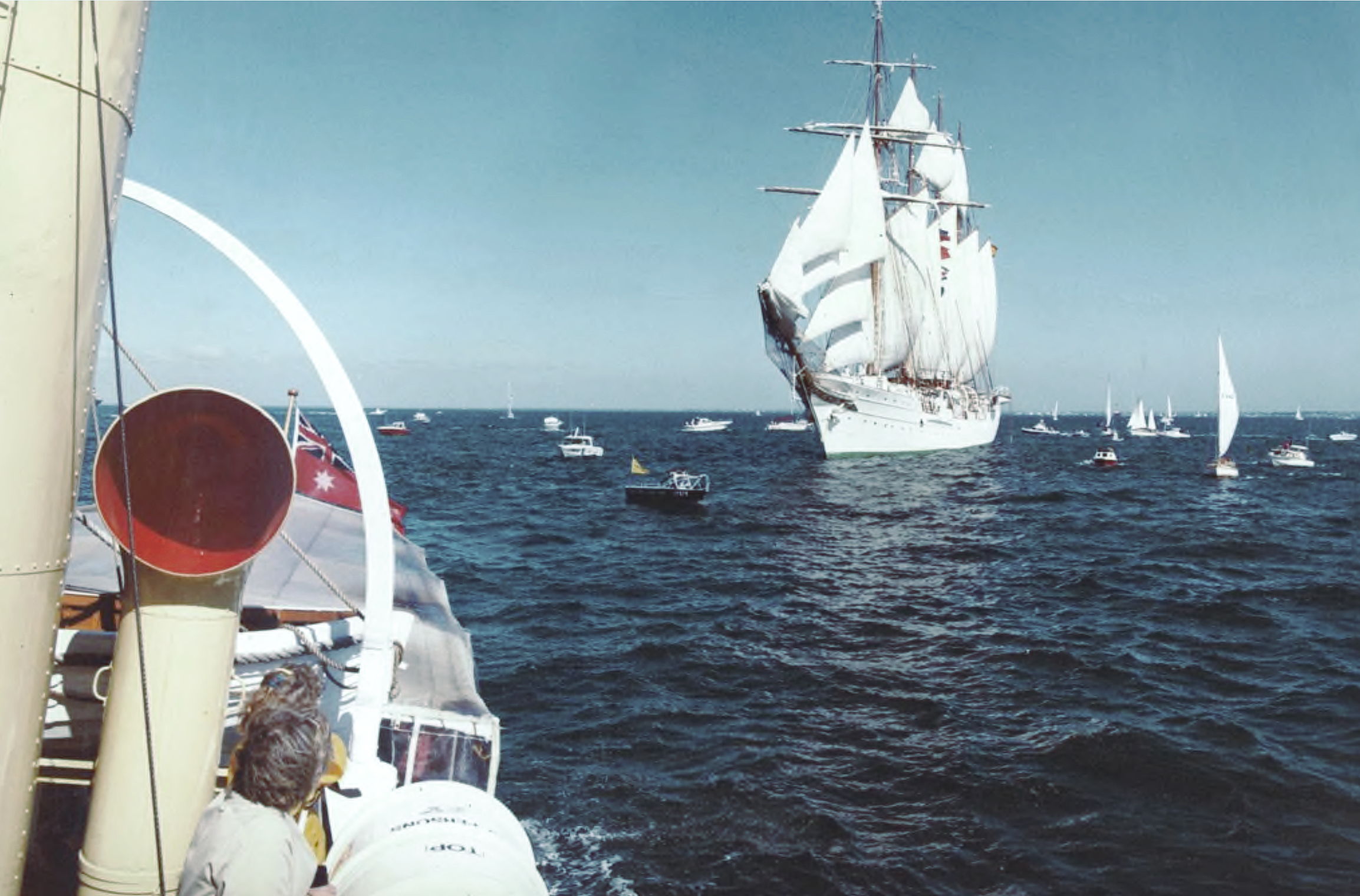
With Juan Sebastian De Elcarno, December 1987, Peter English
On 16 June 1993, the National Trust of Victoria awarded Wattle a citation recognising it as "historically, socially and technologically significant at the National level as the only small harbour steam tug surviving in Australia, and one of only three Australian built steam tugs still in existence and one of only eight Australian built steamships surviving on the Australian coast. She was built at Cockatoo Island Dockyard during the Great Depression on speculation as an initiative to keep the yard's apprentices employed - the standard of workmanship considered to be unusually high. Of rivetted steel hull with experimental electrical welding used to build the bulkheads and fuel bunkers - the first time this new technology was used in an Australian shipyard. All steam engines and boilers were built in Australia and the Wattle is one of only three steamships fitted with a compound steam engine still surviving in Australia. The vessel is the first oil fired steam tug in Australia and the only oil fired steamship fitted with natural draught still existing in Australia. She served all her working life with the Royal Australian Navy. Internationally, the Wattle is one of only twenty-two small harbour steam tugs preserved in the world and one of only twelve oil-fired steam tugs still surviving. Using the International Register of Historic Ships as a guide, there are no more than fifty-eight steam tugs preserved world-wide."
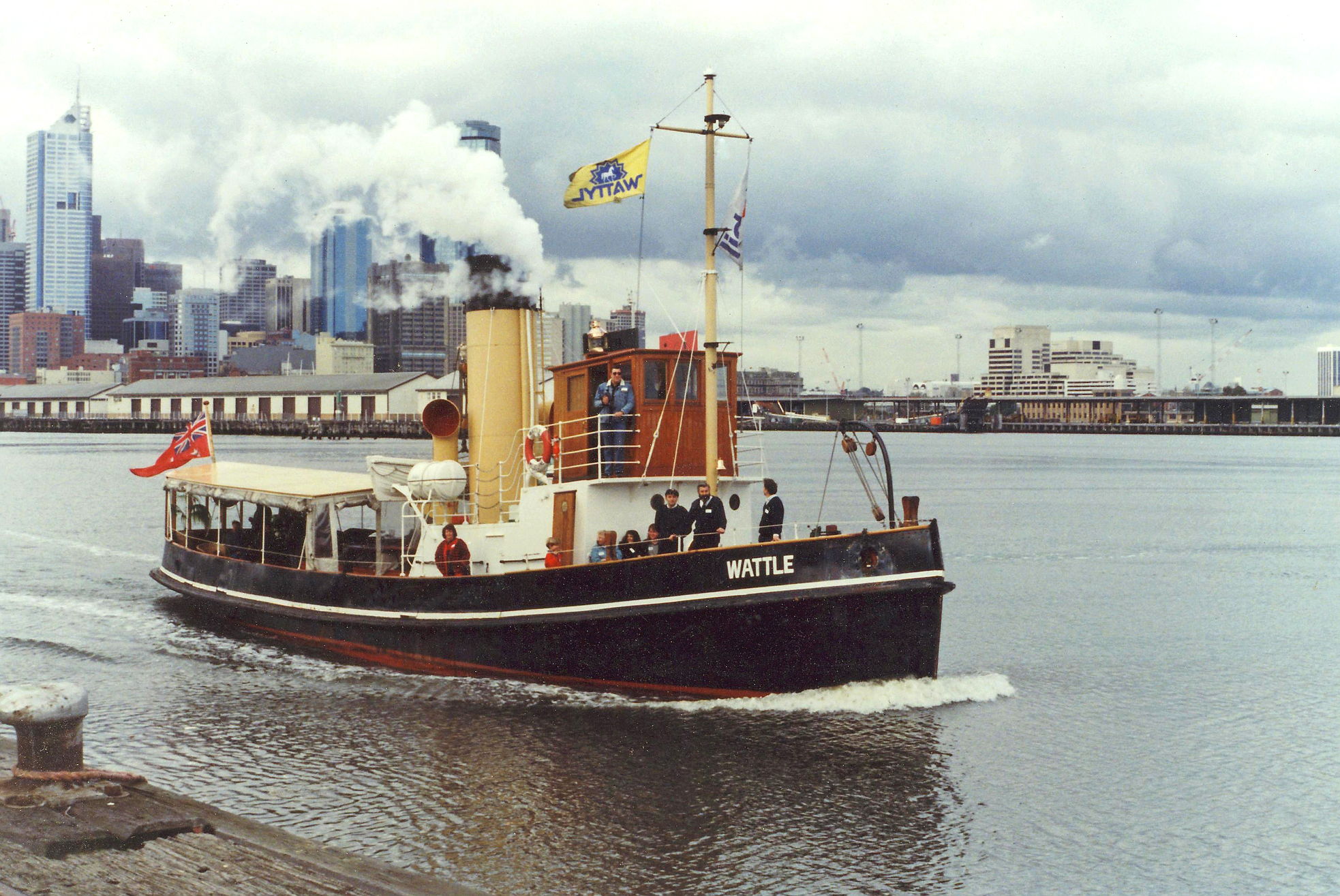
Steaming out of Victoria Dock 1993, Jeff Malley

Wattle and Canberra at Station Pier 1997, Andrew Mackinnon
However, growth and popularity created problems for Wattle and the VSA. One ongoing issue was raising volunteer crews to meet demand as charter work during the working week expanded. Frantic "ring arounds" the day before to locate qualified volunteer Masters, Marine Engineers, deck crew and greasers was a frequent occurrence.
Another problem was finding slipways to accommodate Wattle for major maintenance at a reasonable cost. Wattle was slipped five times in the period 1980 to 2009, at Williamstown (1987), Geelong (1990), twice at Appleton Dock Melbourne (2001 and 2002), and Hastings (2008) in Westernport Bay.
Other VSA activities were creating tensions within the membership. Much of this centred on the search for another steam vessel to restore and eventually run alongside Wattle. Some VSA members set up a separate company called Bay Steamers Ltd, which in 1987 acquired Lyttelton II, a 300 ton twin-screw triple expansion coal-burning tug. The protracted financial and physical effort required to restore Lyttelton II was too much for the volunteers of the VSA, resulting in internal differences, legal costs and a change in name and management.
From August 1997 the Victorian Steamship Association was extinguished, with Bay Steamers Maritime Museum Ltd (BSMM Ltd) replacing it and taking ownership of Wattle. Lyttelton II remained under the ownership and management of Bay Steamers Ltd, a separate entity but with a Board of Directors drawn from BSMM Ltd members. Later due to financial difficulties Bay Steamers Ltd disposed of Lyttelton II and dissolved the organization.
By 2002, problems were emerging with the condition of Wattle's hull, resulting in her dry docking at Appleton Dock slip on the Yarra. Survey restrictions also confined steamings to Hobsons Bay. During 2003 commercial services were suspended, and in January 2004 survey for Wattle was withdrawn, and it was laid up at various berths in the now renamed Victoria Harbour (formerly Victoria Docks) and Docklands precinct.
Whilst not allowed to operate as a commercial passenger vessel, Wattle could still do limited steaming in the confined waters of the Yarra and Hobsons Bay with prior approval from the marine authority. In March 2004 she steamed from Victoria Harbour to Williamstown and back to participate as a moored exhibit for the Heritage Boat Show, and on 25 January 2008, BSMM members steamed to Williamstown to inspect the visiting barque James Craig.
The deteriorating condition of the ship presented BSMM with a serious financial issue. Major hull restoration work was required, there was no income from paying passengers, and no sponsors or benefactors came forward despite extensive media appeals. The future for Wattle looked grim unless a source of funding could be found for the significant work.
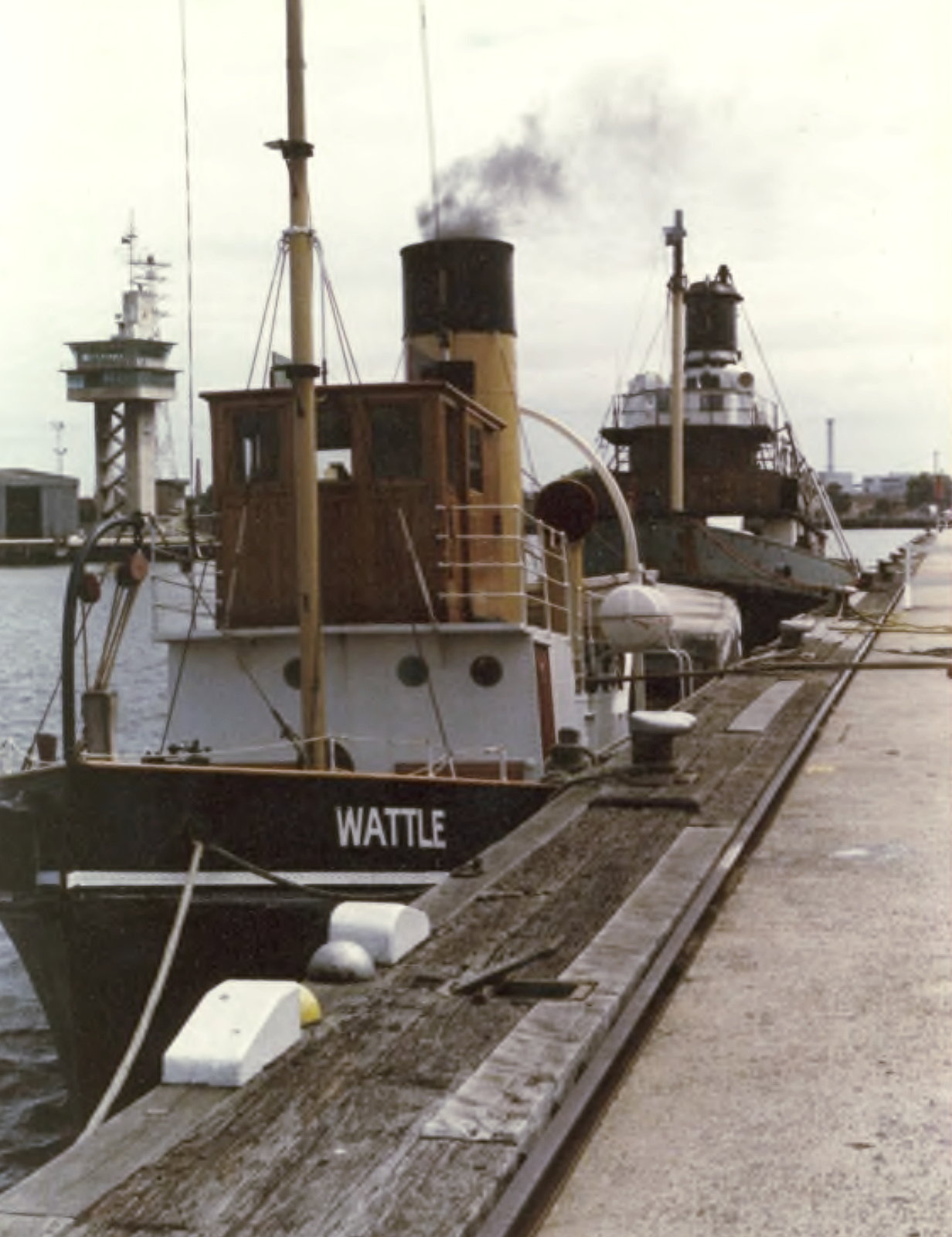
With Lyttelton II 1989, Jeff Malley
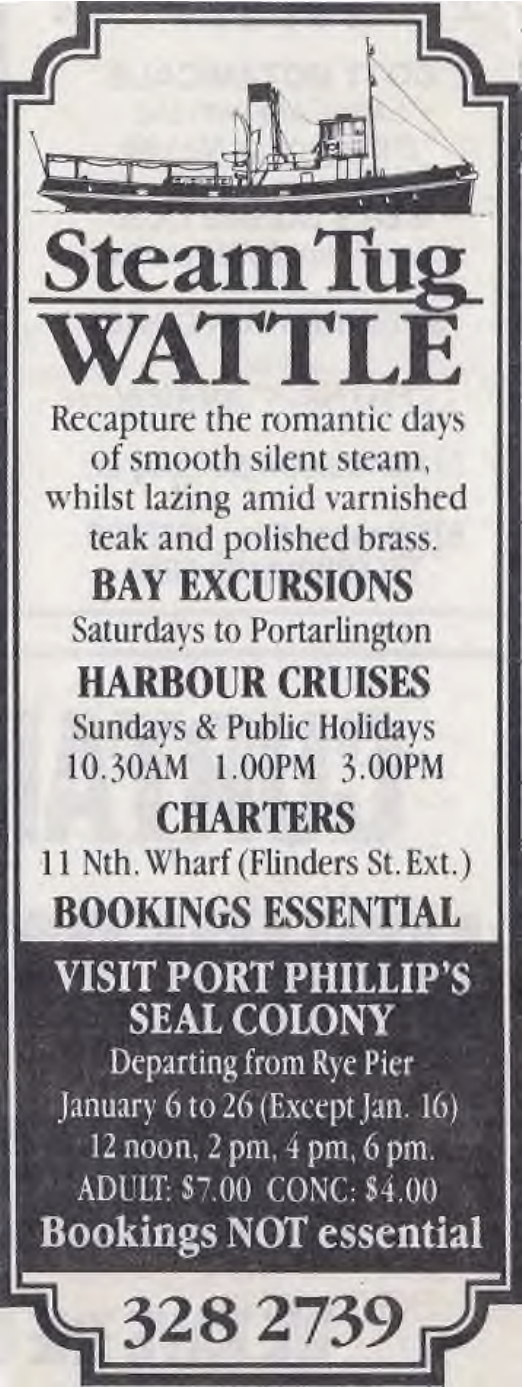
Newspaper ad 1990

With James Craig, Williamstown 2008, Jeff Malley
In early 2007 a group of businessmen formed Sorrento Steam to re-establish a steam tram service at Sorrento on the Mornington Peninsula, but the difficulties of this project led them to look at other possibilities, and in 2007 Sorrento Steam initiated discussions with BSMM on ways to save the Wattle.
On 8 April 2008 Sorrento Steam purchased Wattle for $1 and formed an agreement with BSMM for both entities to co-operate and do all that was necessary to restore Wattle to an approved seaworthy state, with Sorrento Steam covering restoration and survey costs. In June 2008, the tug was taken to Westernport for slipping, but it became clear the hull was more badly corroded than previously thought, and Wattle returned to Melbourne.
On 19 September 2008 the Australian National Maritime Museum placed Wattle on the Australian Register of Historic Vessels. But at North Wharf the tug waited beside Alma Doepel, both ships urgently requiring lifting out of the water due to their deteriorating hulls.
After careful analysis of skills and finances, and the offer from Parks Victoria of a site at 19 South Wharf for a peppercorn rent, Sorrento Steam and BSMM decided to restore Wattle with a mix of volunteer labour and specialist contractors.
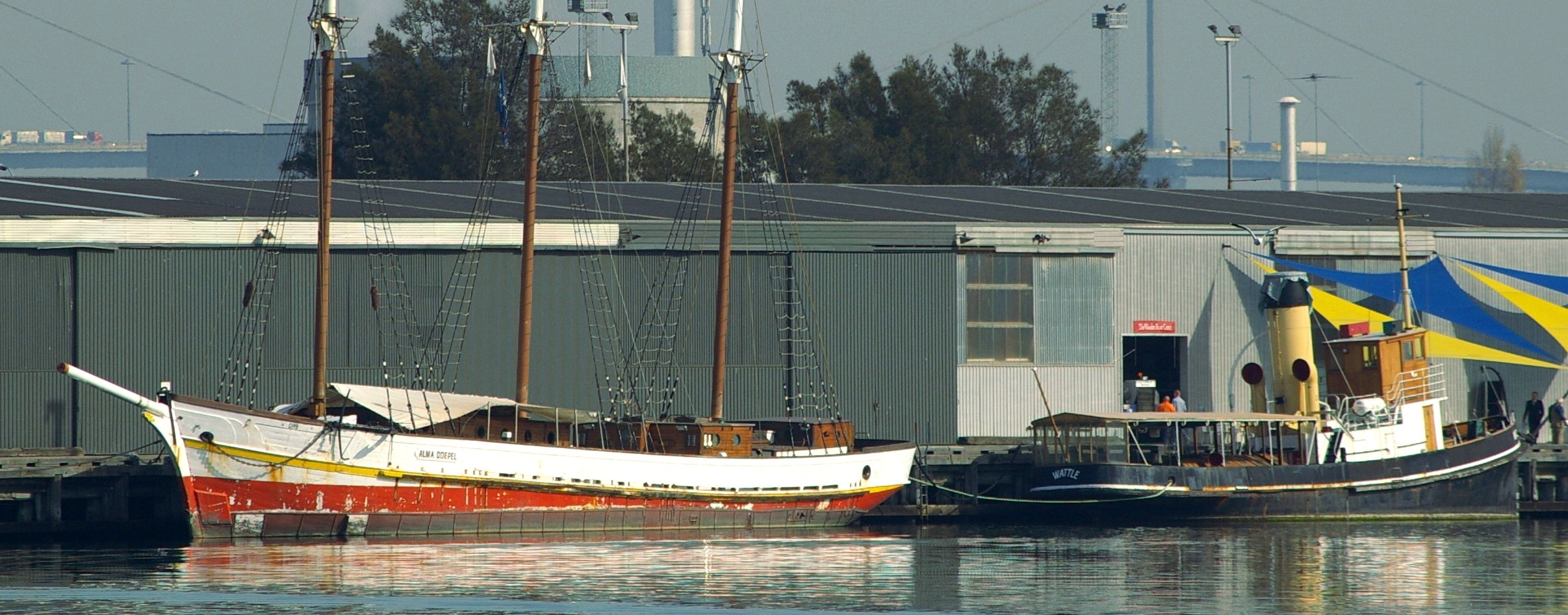
Awaiting restoration: Alma Doepel and Wattle, North Wharf 2008, Jeff Malley
On 22 October 2009 Wattle was lifted out of the water by two large mobile cranes, placed on a low loader and transported under Bolte Bridge to a specially prepared hard berth adjacent to 19 South Wharf.
Once Wattle was settled on her engineering-designed blocks and staunchions the surrounding area became a mini shipyard, with shipping containers converted to workshops for engineering, tools, woodwork, administration, galley and storage.
It became apparent the reason for the hull's very poor condition was the placement in the early years of the ship of concrete ballast with embedded steel ingots along the length of the ship from the waterline down. After some seventy years of seawater penetration between the ballast and the ship's frames and plates the result was extensive corrosion from the inside out.
Early restoration priorities concentrated on the hull, engine room components and the salvage and restoration of timber fittings.

Lift out for restoration, October 2009, Lindsay Rex
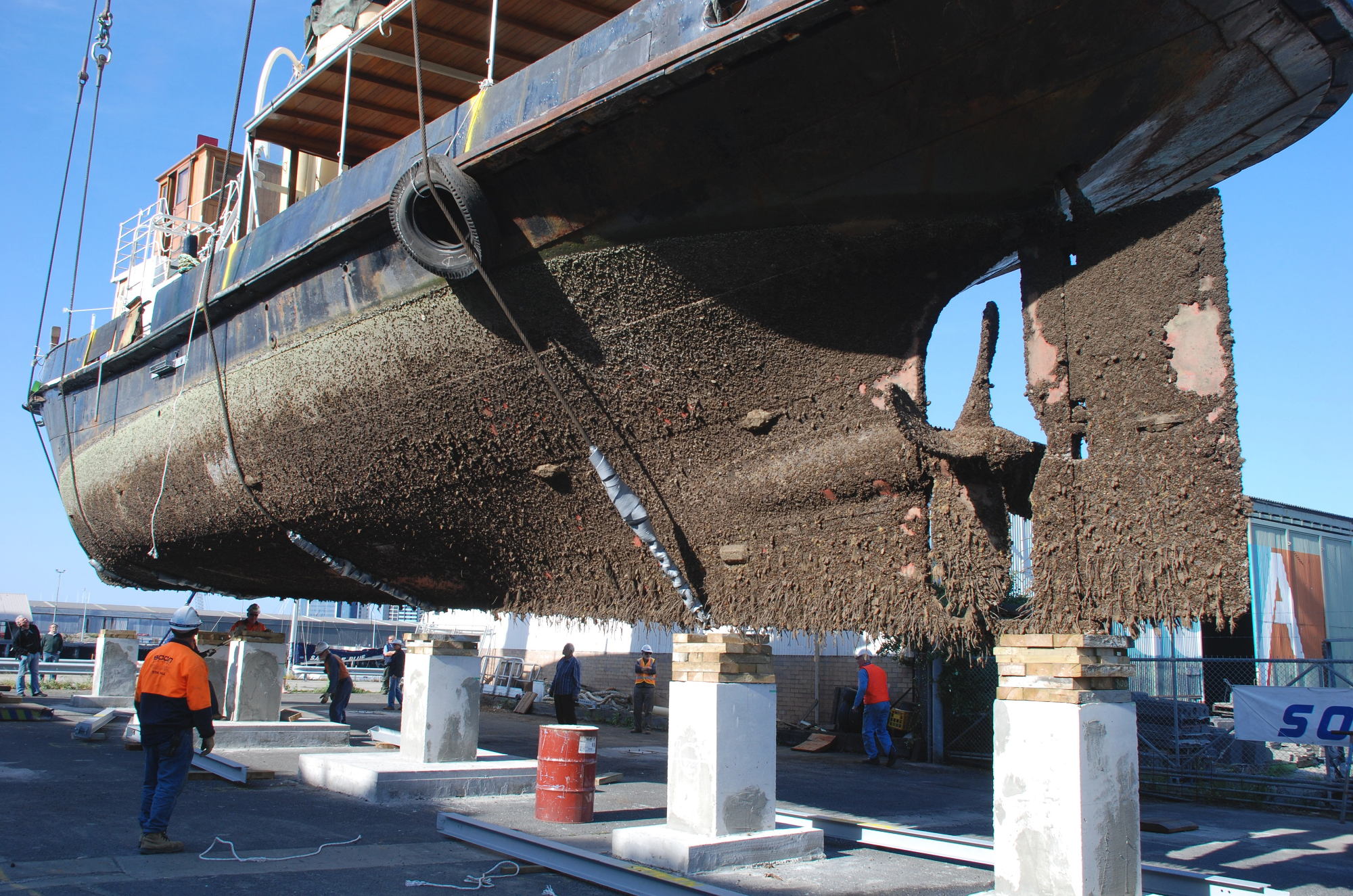
Years of marine growth, October 2009, Lindsay Rex
Major activities included the removal of concrete ballast, corroded plates and frames, and the removal of the rudder and post, steering quadrant and propeller.
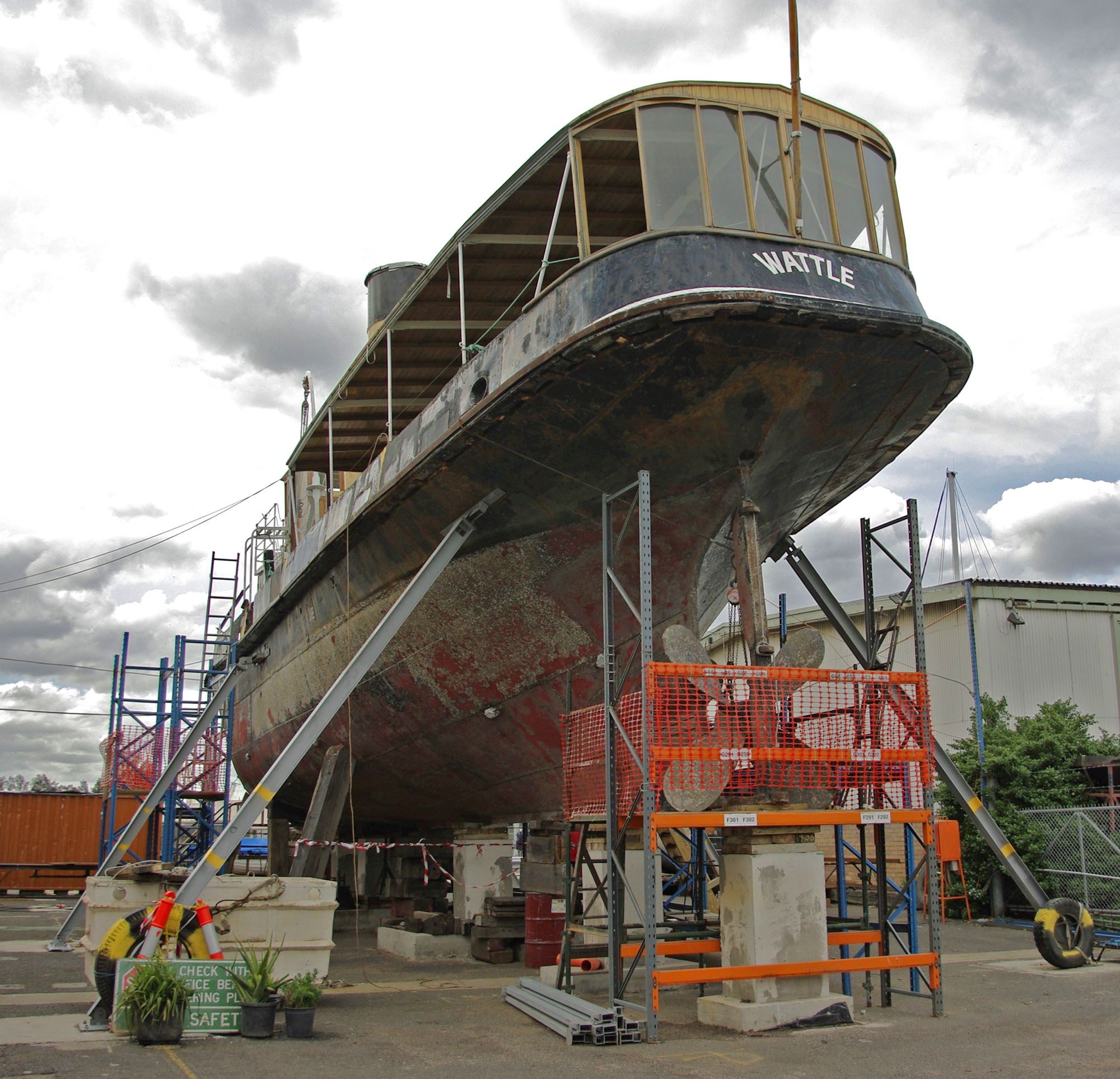
Restoration under way, December 2010, Jeff Malley
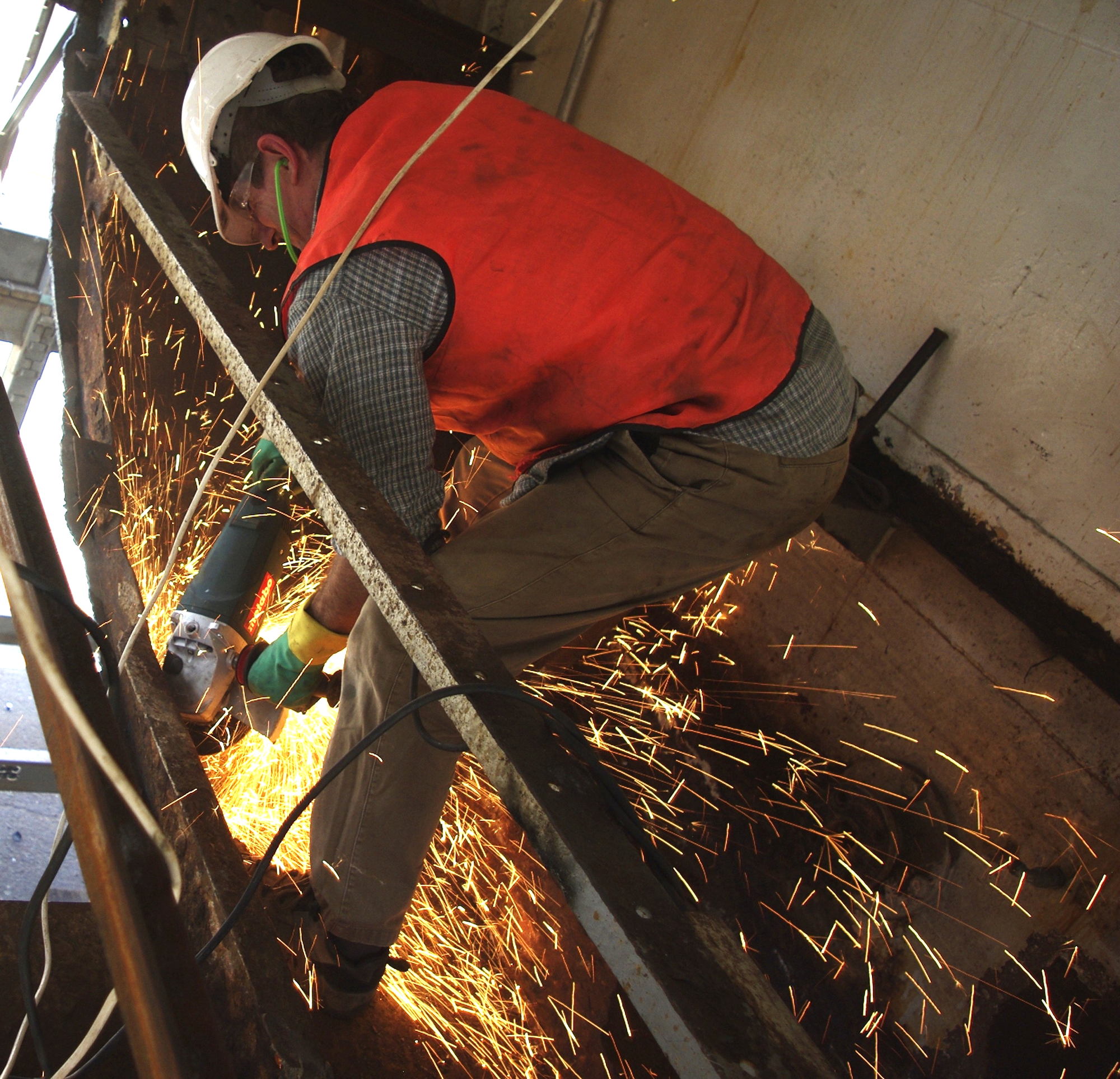
Cutting out forward starboard plates, 2010, Jeff Malley
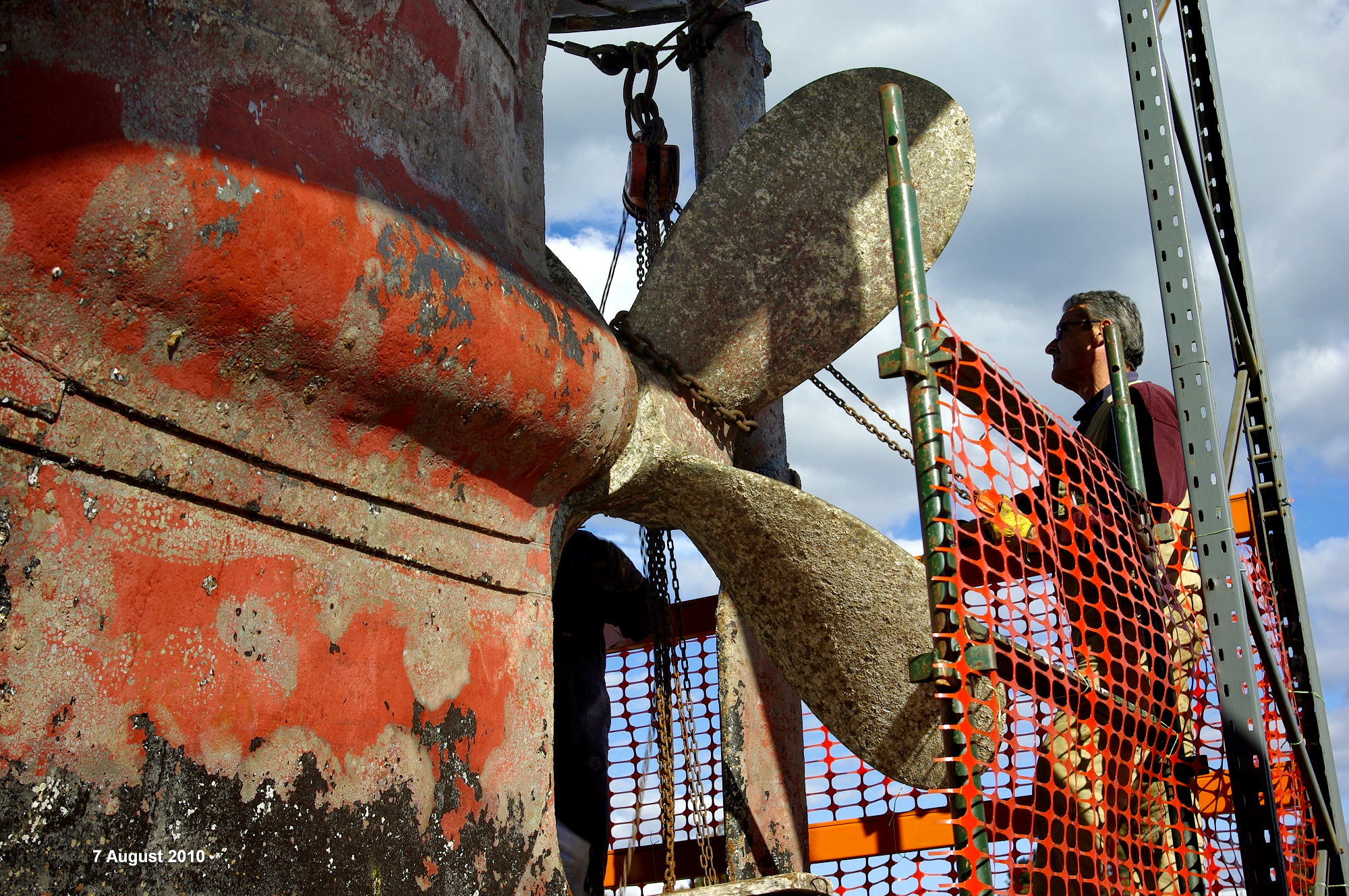
Preparing to remove propeller, August 2010, Jeff Malley
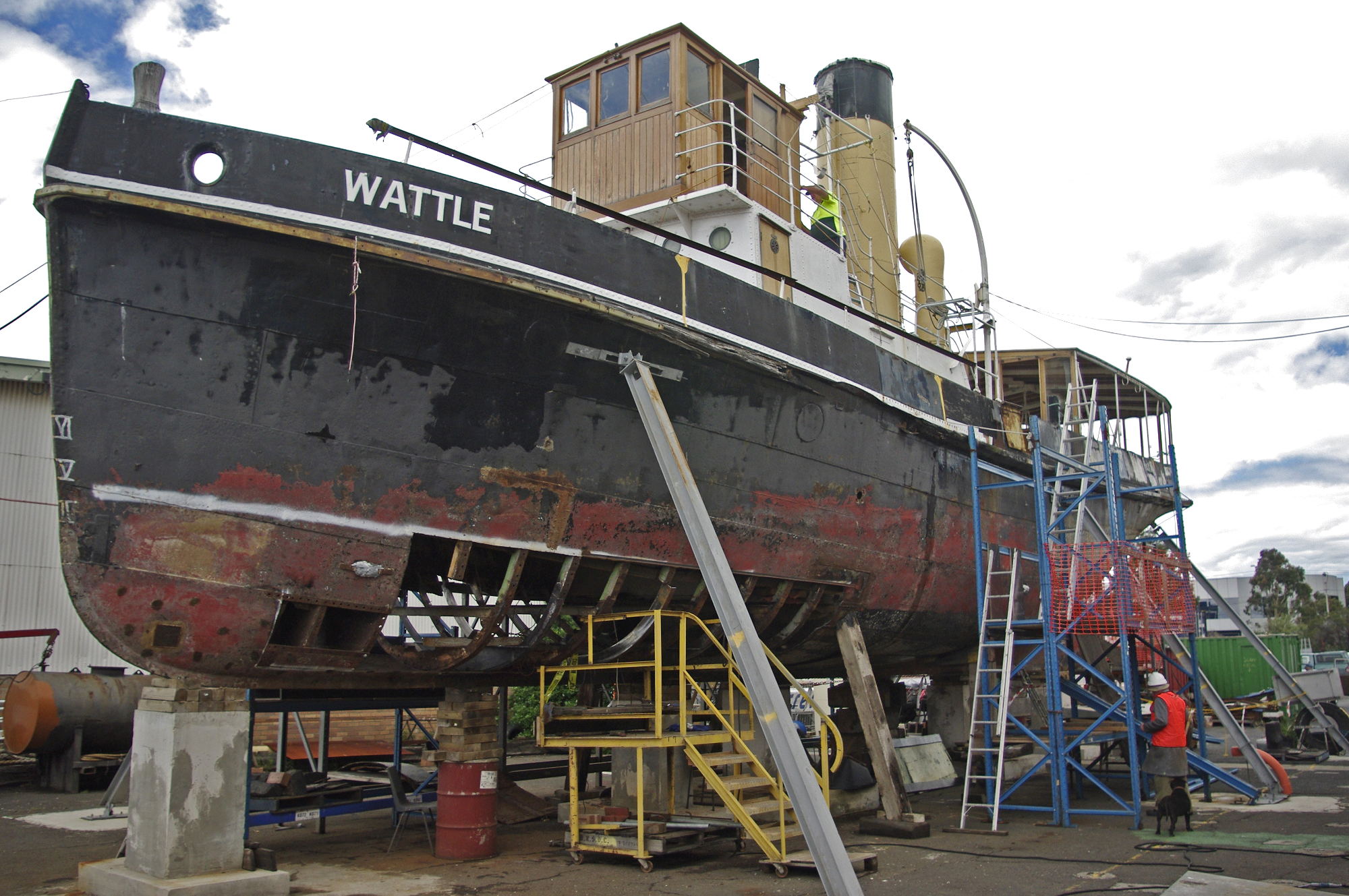
Corroded forward frames and plates removed, 2010, Jeff Malley
In 2015 the ship's new propellor and rudder were installed, along with work on the boilers and pumps, while topsides a new timber decking was laid. Wattle was undercoated and painted in her new livery with a green hull.
But it was a race against time. The downstream creep of new high rise apartments was continuing, and developers were starting to demolish buildings adjacent to the site. In early 2015 BSMM were told by Places Victoria and Mirvac they would have to vacate by 30 June that year. After negotiations BSMM were able to stay a few months longer, and Wattle's return to the water was planned for the end of September 2015.
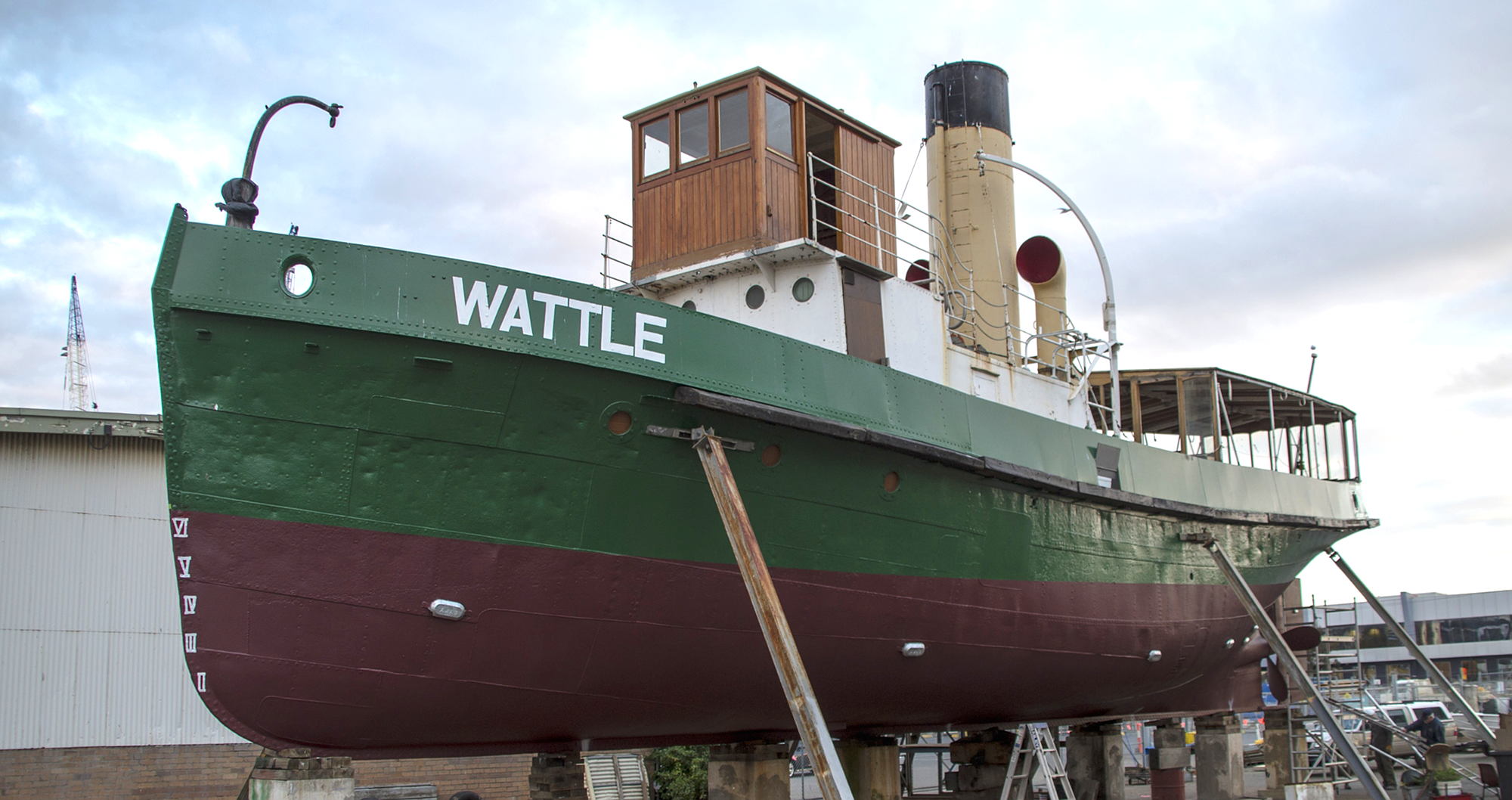
Hull restored and ready for launch, 29 September 2015, Jeff Malley
"Sometimes we despaired. Sometimes we were heavy-hearted. Sometimes we almost gave up. Sometimes we kicked the walls in frustration. But we stuck at it and got our answer and our reward at about 7.00pm on Wednesday 30 September 2015, when Wattle touched the water again." — Tony Lewis, Board

The lift, South Wharf, 30 September 2015, Jeff Malley
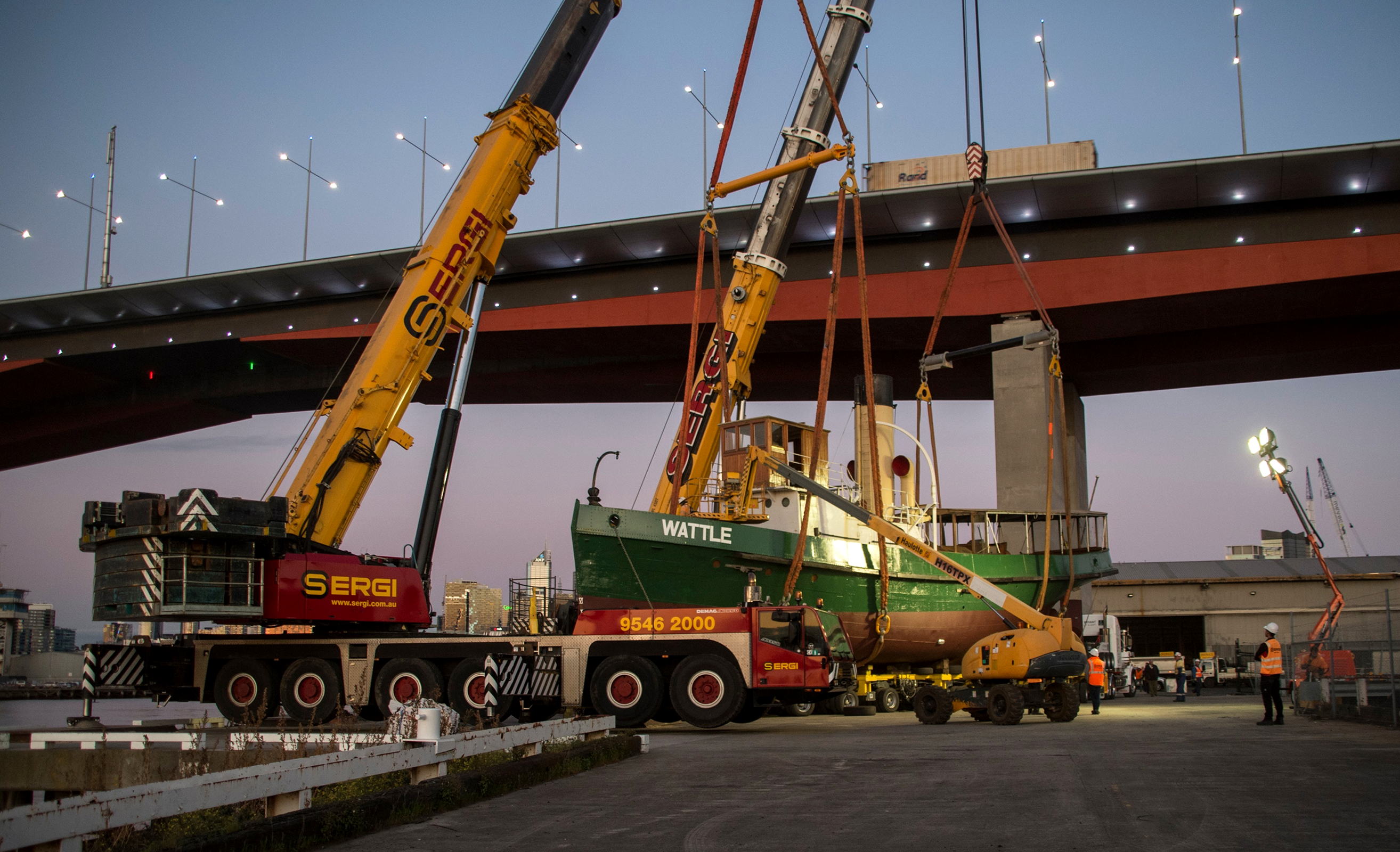
Off the low-loader, 30 September 2015, Jeff Malley

Lowering Wattle into the Yarra, 30 September 2015, Jeff Malley
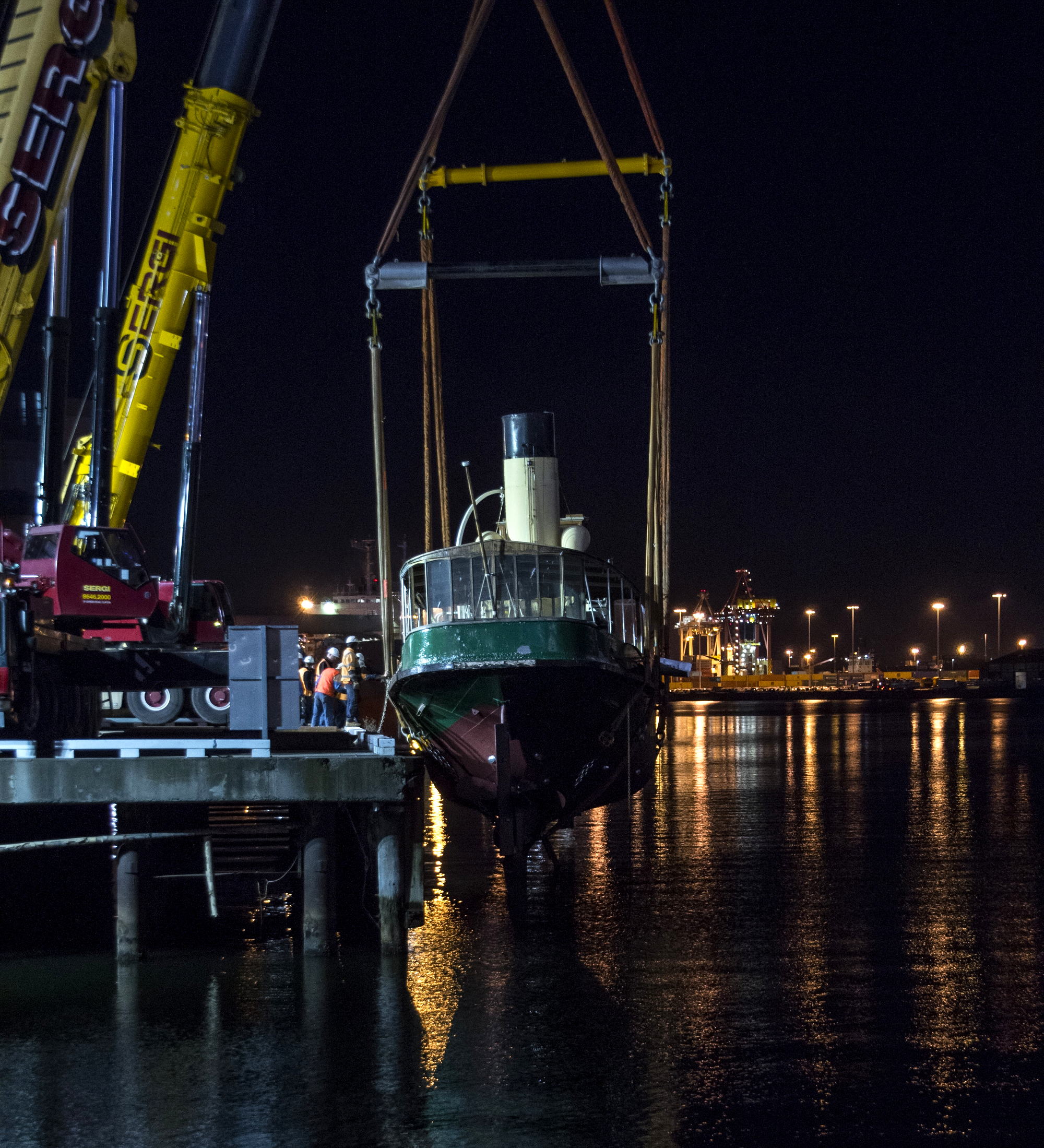
About to touch the water, 30 September 2015, Jeff Malley
After much hard work by volunteers, Bay Steamers Maritime Museum returned Wattle to the water in 2015.
Apart from relaunching Wattle, other jobs since 2009 included extensive de-scaling, repair, preparation and painting of many parts of the ship; re-installation of rudder/tiller, overhaul of steering engine, all shipside valves, fuel oil and sea water circulating pumps, boiler valves, all main bearings, both cross headbearings and LP cylinder bearing, replacement and refitting of LP piston cylinder rod, and steam pipe pressure testing.
Since lift-out in October 2009, volunteers had put in about 16,000 hours of labour. Applying the same rates that contractors use to those hours, work was contributed to a value of somewhere between $750,000 and $1,000,000. And the efforts continued.
The renovation site moved to another South Wharf site for some months, then in February 2016 moved again to Shed 2 North Wharf on Victoria Harbour, Docklands, where Alma Doepel is also berthed. Shed 2 had workplaces and storage, light and power, a dedicated office and a library, and after all the delays of moving, renovation was able to begin again in earnest.

Moving to North Wharf, February 2016, Jeff Malley
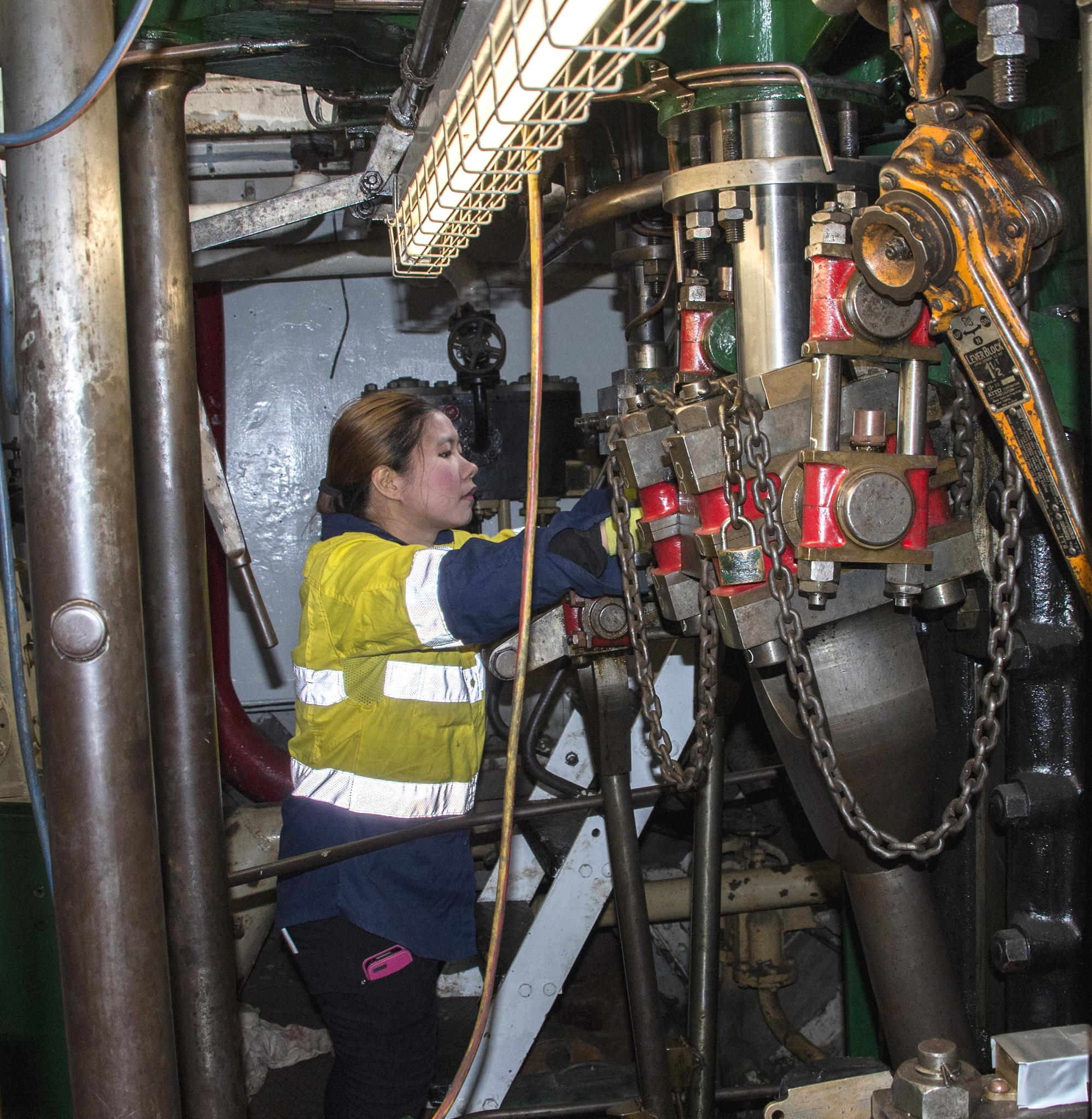
Checking oil boxes and wicks 2016, Jeff Malley
Work began on seating, electricals and installation of a diesel generator, as well as many items of woodwork (re-installation of bulwark cappings, re-furbishing steering engine cover, commencement of wheelhouse lining and cabinetry, navigation light screens), and refurbishment of the helm stand, steering system and windlass.
By the end of 2017 we had carried out major repairs and maintenance to the main engine, with works to bearings, valves and actuators, reversing gear, filters, lubrication system. We repaired tanks and valves, installed a new mast, overhauled the steering engine and gear train, installed a diesel generator, completed painting the ship and installed galley benches and dumb waiter trunk.
We finished steel deck repairs and timber deck caulking, installed toilet doors, bulwark capping, repaired the canopy and re-installed vents and companionways. We had the boiler inspected and passed, repaired the refractory, overhauled the registers and re-installed the gauge glasses. Importantly, we also prepared a set of operational and systems drawings to cover the engineering details of the ship.
By the end of 2018, we'd tested the boiler, completed the repairs to the GS pump and other engine room machinery, prepared for steaming trials, and were very close to completing the fit-out of the wheelhouse, plumbing the galley and toilets, finishing the electrical installation and the diesel generator hook-up, and installing the navigational aids. Little remained to be done in the Engine Room apart from cleaning, polishing and touching up paint, and electrics, plumbing and fire warning systems were almost complete.
In 2019 marine surveyors are assessing the amount and location of ballast required, then we are into trials and testing - and at last our new program of cruises and events will begin!
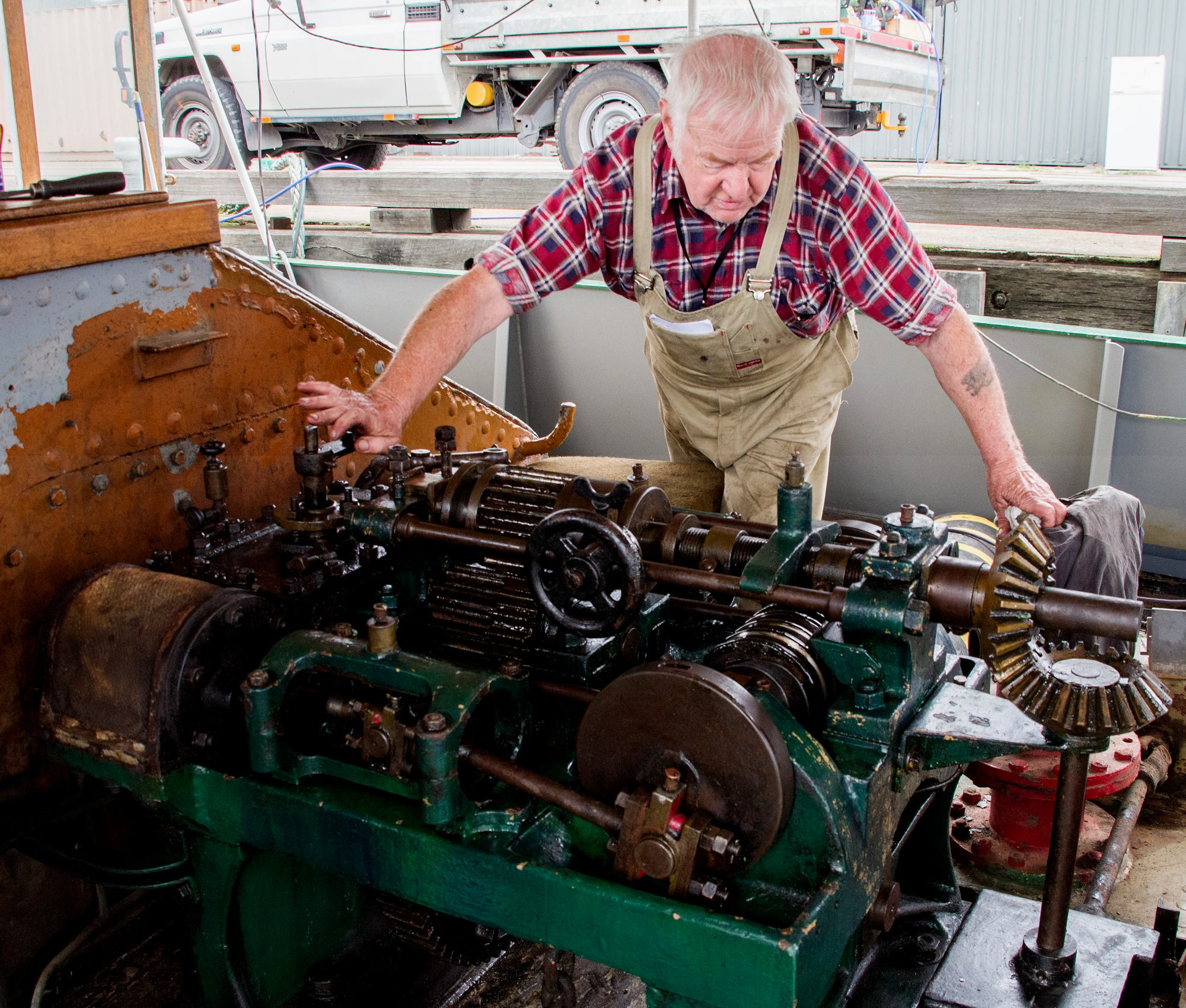
Volunteer engineer inspecting steering engine 2016, Jeff Malley
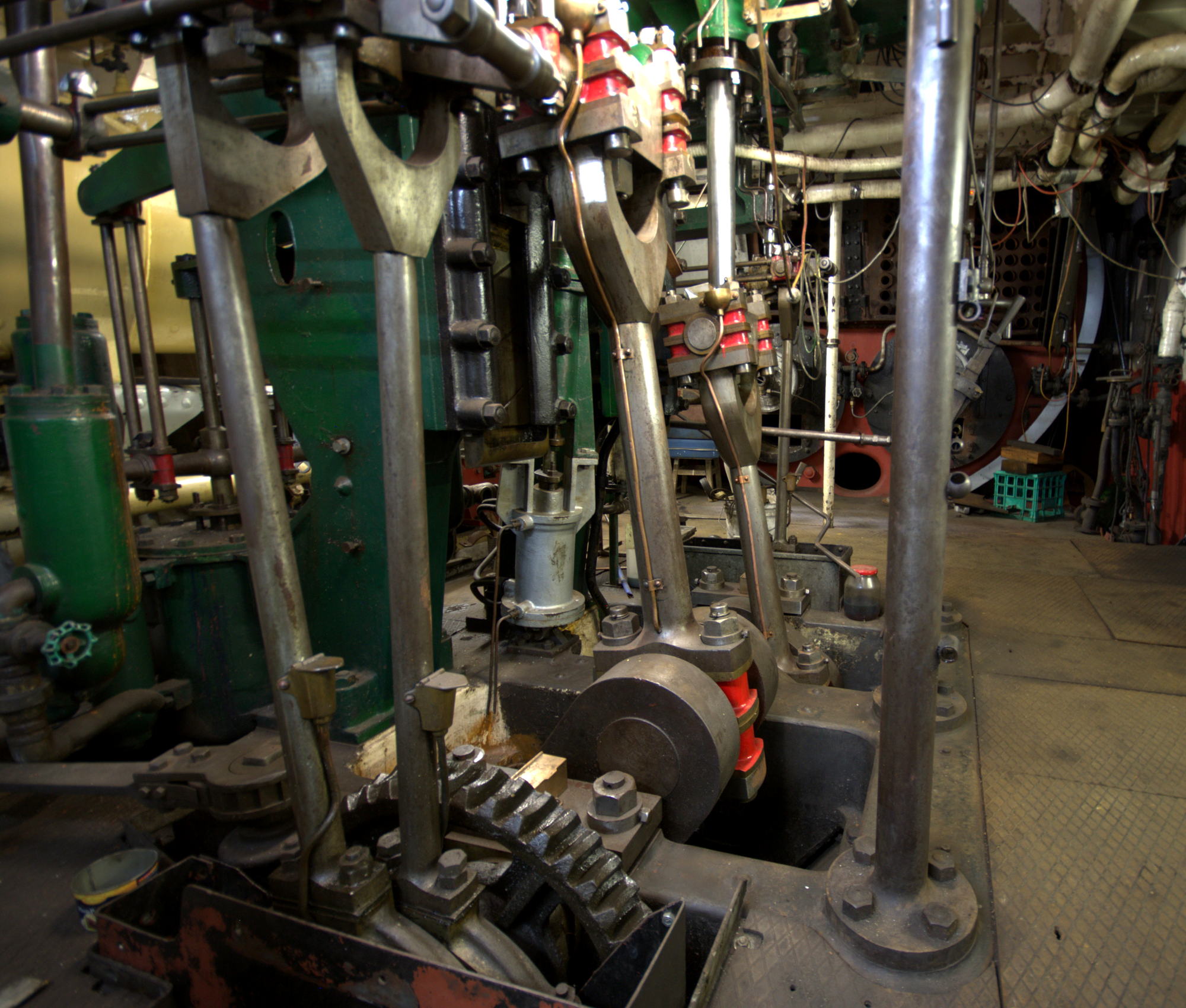
Engine room with boilers in background 2017, Jeff Malley

Mast stepped beside Alma Doepel, February 2018, Jeff Malley

Plans and decisions, October 2018, Jeff Malley

Builder's plaque and artifacts, February 2019, Jeff Malley

North Wharf with Enterprize, 2019, Jeff Malley

'Prisoners' TV series reunion, February 2019, Jeff Malley

Melbourne city sunrise and a new day for Wattle, Jeff Malley
In 2026, the Steam Tug Wattle began a significant new chapter by relocating to Williamstown. The large machinery was trucked over to our new workshop space at SeaWorks. In coming weeks we will progressively move containers into place and unpack those that are not remaining.
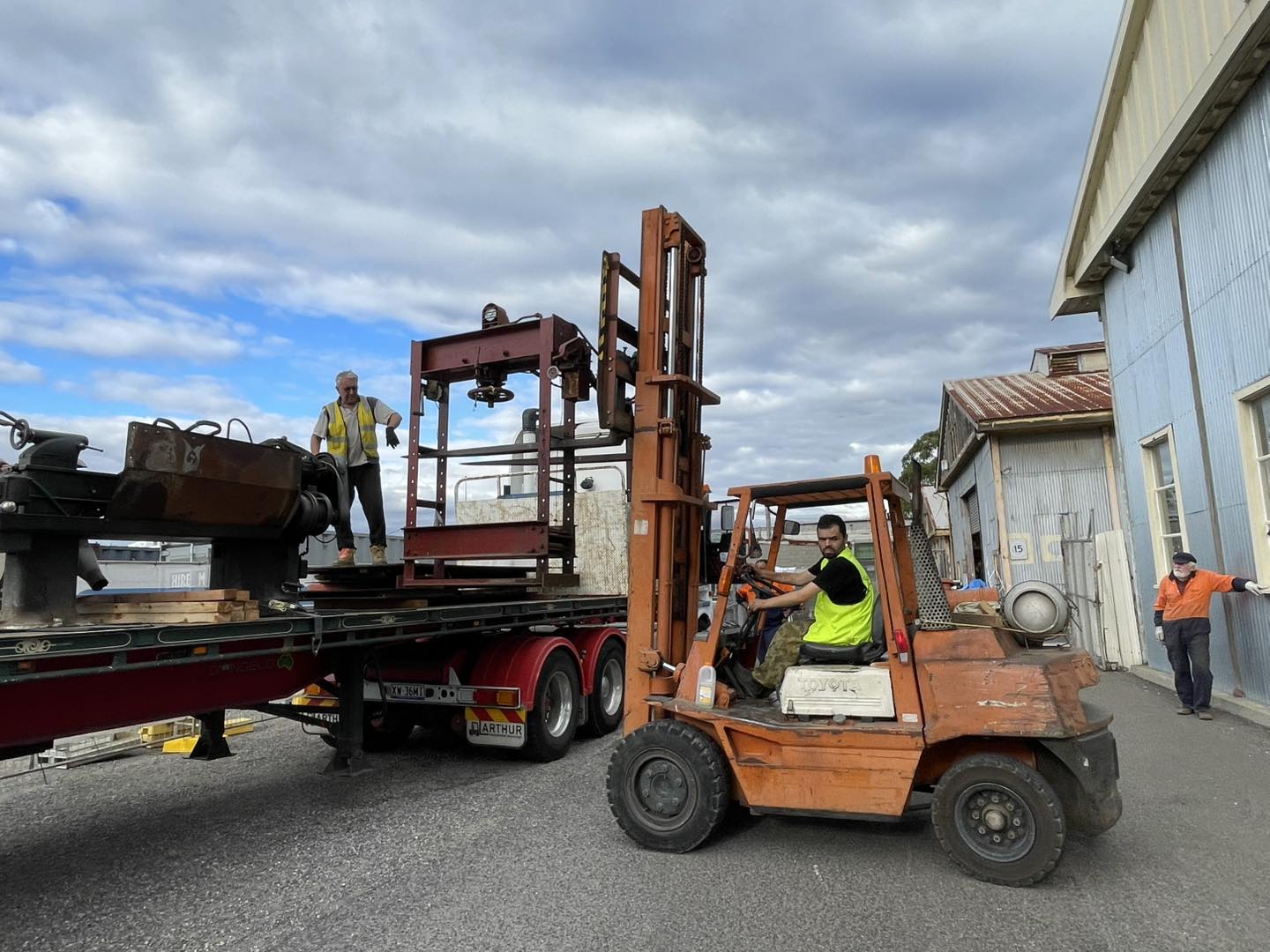
Machinery being moved to SeaWorks, Williamstown